

American Academy of Family Physicians research shows that knee pain affects 25% of American adults and that knee pain prevalence has increased by 65% within the last 20 years. If you’re a knee pain patient, you’ll know that debilitating knee pain impacts quality of life and limits daily activities. Whether you’re dealing with a sports injury, arthritis, or other forms of chronic knee discomfort, finding effective treatment can be frustrating when traditional approaches provide only temporary relief.
As regenerative medicine advances, patients are discovering alternatives to surgery and long-term medication dependency that repair damaged tissue rather than simply masking symptoms.
Understanding your treatment options empowers you to make informed decisions about your health. This FAQ guide will help you recognize knee injury symptoms, understand why conventional treatments often fall short, and explore how stem cell therapy is transforming the management of knee pain for patients seeking lasting relief.
Below are answers to the most commonly asked questions surrounding knee pain.
What are the most common symptoms that indicate I have a knee injury requiring professional medical attention?
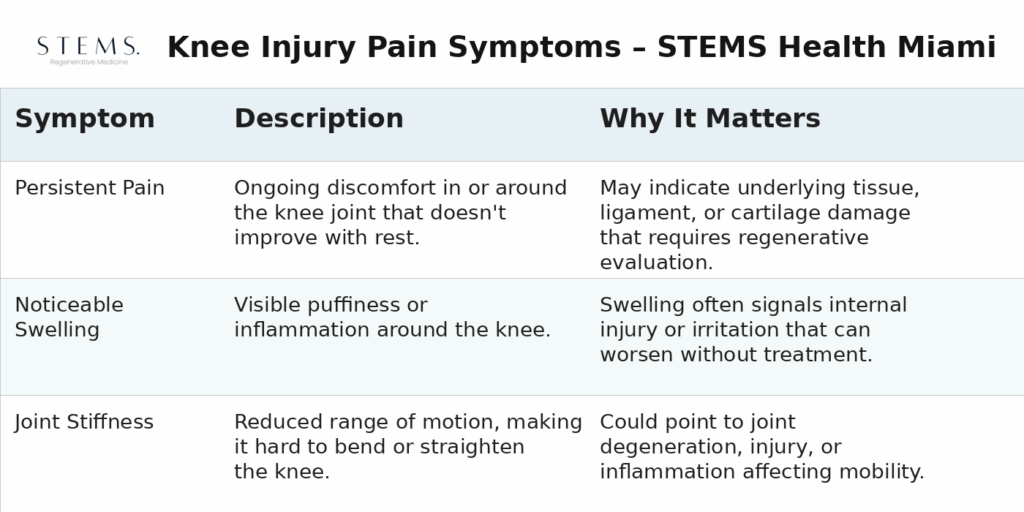
The hallmark symptoms of knee injury include:
- Persistent pain
- Noticeable swelling
- Joint stiffness that limits your range of motion
These primary indicators often develop gradually but may appear suddenly following trauma.
You should seek immediate medical evaluation if you experience a sudden onset of severe pain, inability to bear weight on the affected leg, visible deformity of the knee, or a “popping” sensation followed by immediate pain and swelling. These symptoms suggest you have significant structural damage requiring urgent medical care.
Early-stage symptoms might seem manageable with rest and over-the-counter medications, but this can be deceptive. Neglecting proper treatment during the initial injury phase can lead to progressive joint deterioration and permanent knee damage that may eventually require surgical intervention.
What typically causes knee injuries, and how do these injuries lead to long-term problems?
Knee injuries stem from various sources, with the most common being fractures to the surrounding bones (femur, tibia, or fibula), ligament tears affecting the anterior or posterior cruciate ligaments, and traumatic rupture of blood vessels causing fluid accumulation in the joint space.
Additional causes include kneecap dislocation, muscle tears in the quadriceps or hamstring groups, and patellar tendon ruptures. Sports activities, workplace accidents, and age-related wear and tear contribute significantly to these injury patterns.
These injuries create a cascade of inflammatory responses that, if left untreated, can damage healthy cartilage, weaken supporting structures, and ultimately destroy the knee’s structural integrity. The initial trauma often triggers chronic inflammation that continues damaging tissue after the original injury, creating a cycle of progressive deterioration.
How do doctors typically diagnose knee injuries, and what should I expect during evaluation?
Knee injury diagnosis begins with a comprehensive physical examination where your doctor assesses joint stability, range of motion, and pain responses to specific movements. This clinical evaluation includes tests for ligament integrity and joint alignment.
Following the physical assessment, imaging studies provide detailed visualization of internal structures. X-rays serve as the initial diagnostic tool to identify fractures or bone abnormalities, while MRI scans reveal soft tissue injuries involving ligaments, cartilage, or tendons.
The diagnostic process helps determine the severity and guides treatment recommendations, from conservative management to advanced regenerative therapies. Your doctor will also review your medical history, activity level, and treatment goals to develop a personalized approach to your recovery.
Why do traditional knee treatments often provide only temporary relief?
Conventional knee treatments typically focus on symptom management rather than addressing the underlying tissue damage causing your pain.
The standard R.I.C.E. protocol (Rest, Ice, Compression, Elevation) helps manage acute inflammation but doesn’t promote actual tissue repair. Anti-inflammatory medications can temporarily reduce pain and swelling, but they can also inhibit your body’s natural healing processes when used long-term. Physical therapy exercises strengthen surrounding muscles but cannot regenerate damaged cartilage or repair torn ligaments at the cellular level.
When do doctors typically recommend knee surgery, and what are the associated risks?
Orthopedic surgeons usually recommend knee surgery when conservative treatments fail to provide adequate pain relief or restore function after several months. Surgical options range from arthroscopic procedures to clean out damaged tissue, to total knee replacement in severe cases.
However, knee surgery carries significant risks. The Mayo Clinic highlights infection, blood clots, nerve damage, and prolonged recovery periods as potential risks of knee surgery. Additionally, surgical outcomes aren’t guaranteed, with some patients experiencing persistent pain or complications that require additional procedures.
How can stem cell therapy address knee injuries more effectively than traditional treatments?
Stem cell therapy represents a paradigm shift from symptom management to actual tissue regeneration. Unlike conventional treatments that merely mask pain or remove damaged tissue, stem cell injections introduce powerful regenerative cells directly into the injured area.
Mesenchymal stem cells possess the ability to differentiate into cartilage, bone, ligament, and tendon tissue, rebuilding the structures that traditional medicine cannot restore. Stem cell knee pain treatment also modulates inflammation, promotes blood vessel formation, and creates an optimal healing environment that supports long-term knee joint health.
What types of knee conditions respond best to stem cell treatment?
Stem cell therapy studies have shown exceptional potential for a wide range of knee conditions, including the following:
- Osteoarthritis with cartilage loss
- Meniscus tears
- Ligament injuries (ACL, MCL, PCL)
- Patellar tendonitis
- Chronic knee pain from previous injuries or surgeries
The treatment is particularly effective for patients who have failed traditional therapies or want to avoid surgery.
Even patients with advanced arthritis often experience significant improvement in pain levels and joint function. One factor to consider is that stem cells work best when some healthy tissue remains, making early intervention crucial for optimal outcomes.
What should I expect during a stem cell treatment procedure for my knee?
The stem cell procedure at our Miami clinic typically begins with harvesting your cells from adipose (fat) tissue, usually from the abdomen or hip area, through a minimally invasive liposuction technique performed under local anesthesia.
The harvested tissue is then processed in our laboratory centrifuge to concentrate and purify the stem cells. Using ultrasound or fluoroscopic guidance, our board-certified doctors inject the concentrated stem cells precisely into the damaged areas of your knee joint.
The entire process occurs within 2-3 hours during an outpatient procedure, and with minimal discomfort.
How long does it take to see results from stem cell treatment, and what is the recovery process like?
Unlike surgery, stem cell therapy for knee pain requires minimal downtime, with most patients returning to light activities within a few days. Initial improvements in pain and stiffness often begin within 2-4 weeks as inflammation subsides.
Significant functional improvements typically occur between 6 and 12 weeks as new tissue formation progresses. The regenerative process continues for several months, with many patients experiencing continued improvement up to 6 to 12 months post-treatment.
During recovery from stem cell knee pain treatment, you’ll follow a specific rehabilitation protocol built by the STEMS doctors to optimize stem cell integration and tissue development.
Are there any side effects or risks associated with stem cell treatment for knee injuries?
Because stem cell therapy uses your cells, the risk of rejection or allergic reactions is virtually eliminated. The most common side effects are mild and temporary, including slight swelling or discomfort at the injection site that typically resolves within a few days.
Serious complications are rare when procedures are performed by experienced regenerative medicine specialists using proper sterile techniques.
How does stem cell therapy compare to knee replacement surgery in terms of long-term outcomes?
Stem cell therapy offers several advantages over knee replacement surgery, including preservation of your natural joint structure, no risk of implant failure or rejection, and the ability to maintain normal joint biomechanics.
While knee replacements may last 15-20 years before requiring revision surgery, stem cell therapy can provide lasting relief by actually regenerating your tissue.
Doctors can also repeat stem cell treatment if necessary, without the complications associated with revision joint surgery. Many patients who choose stem cell therapy avoid the need for replacement surgery entirely, maintaining their natural knee function well into their later years.
Am I a candidate for stem cell treatment, and how do I determine if this approach is right for my knee condition?
The best candidates for stem cell treatment are individuals experiencing persistent knee pain who want to avoid surgery or have not achieved adequate relief from conventional therapies.
A comprehensive evaluation, including medical history, physical examination, and imaging studies, helps determine your candidacy and develop a personalized treatment plan.
The ideal approach is to schedule a free consultation with our regenerative medicine specialists, who can assess your specific knee condition and explain how stem cell therapy might benefit your particular diagnosis.
Discover Your New Life – Free from Knee Pain
The STEMS Health doctors, Dr. Ankeet Choxi and Dr. Jarred Mait, hold decades of experience treating the root causes of knee pain within our Miami Beach medical clinic. If you’re experiencing chronic knee pain and seeking alternatives to conventional pain relief options, we invite you to schedule your free knee pain consultation. You can also learn more about the potential value of stem cell treatment in your journey towards long-term knee pain relief by calling the STEMS Health Miami Beach office at (305) 315-0815.
