

Table of Contents
Rotator cuff tears are one of the most common causes of shoulder pain. Data from the American Academy of Orthopedic Surgeons shows that two million Americans experience rotator cuff tears and similar shoulder injuries annually. Whether caused by injury, repetitive overhead activity, or age-related degeneration, torn rotator cuffs significantly impact your daily life. Suddenly, simple activities like lifting, reaching, or even sleeping can become a painful challenge.
While surgery has long been considered the standard treatment for significant rotator cuff injuries, advancements in regenerative medicine now offer promising non-surgical options. Treatments like stem cell therapy and platelet-rich plasma (PRP) injections are gaining traction for their ability to promote natural healing and potentially help patients avoid invasive procedures.
What is a Rotator Cuff Tear?
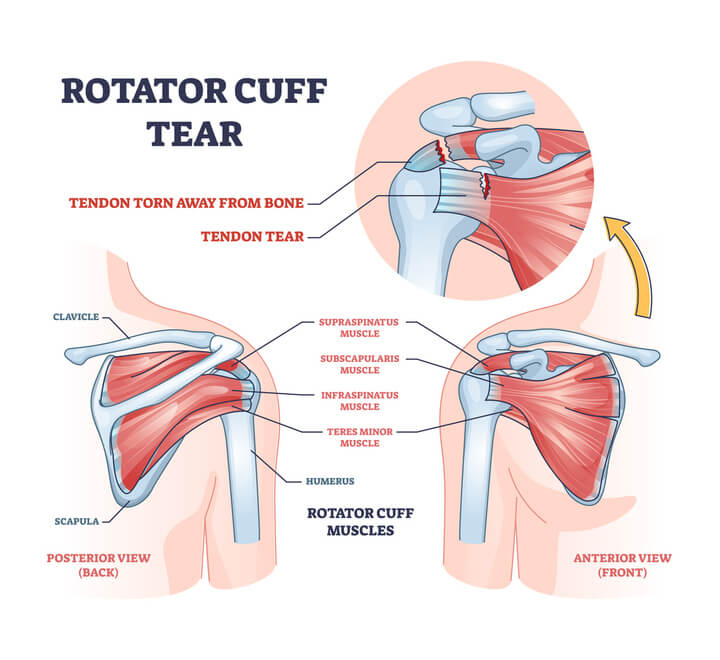
The rotator cuff is a group of four muscles and tendons that stabilize the shoulder joint and allow for a wide range of arm movements. Tears can be partial (where only part of the tendon is damaged) or full-thickness (where the patient has a complete tear).
Common symptoms include:
- Persistent shoulder pain
- Weakness when lifting or rotating the arm
- Clicking or popping sounds with shoulder movement
- Limited range of motion
Identifying the Causes of Rotator Cuff Tears
While we know that the risk of rotator cuff tears rises with age (the data shows approximately 25% of individuals in their sixties and more than 50% of those in their eighties have a current rotator cuff tear), there are varying causes beyond natural aging, including:
- Acute injuries, like falling on an outstretched arm
- Chronic overuse, which is common in athletes or workers doing repetitive overhead movements
- Age-related degeneration, which weakens the tendons over time
Traditional Treatment Options
Conventional treatments for rotator cuff tears typically focus on treating the pain, beginning with conservative care and progressing to surgery if necessary. Options include:
- Physical Therapy
Strengthening the surrounding muscles to compensate for the tear
- Non-steroidal anti-inflammatory Drugs (NSAIDs)
Reducing pain and inflammation
- Corticosteroid Injections
Short-term relief from severe inflammation
- Surgical Repair
Reattaching the torn tendon to the bone, especially for large or complete tears
While surgery is effective for many patients, it carries risks such as infection, stiffness, nerve injury, and sometimes incomplete recovery. It also often requires a lengthy rehabilitation process, sometimes 6 months or more, before patients return to their everyday schedule.
Regenerative Medicine: A Non-Surgical Alternative
Regenerative medicine aims to enhance the body’s healing capabilities. In treating rotator cuff injuries, two leading techniques are:
Stem Cell Therapy
Stem cells can develop into different tissues, including tendons, muscles, and bones, offering significant long-term benefits in targeting complex shoulder pain conditions.
For rotator cuff tears, stem cells are typically harvested from bone marrow (often from the pelvis) or adipose tissue (fat). The cells are then concentrated and injected into the injured area under ultrasound guidance.
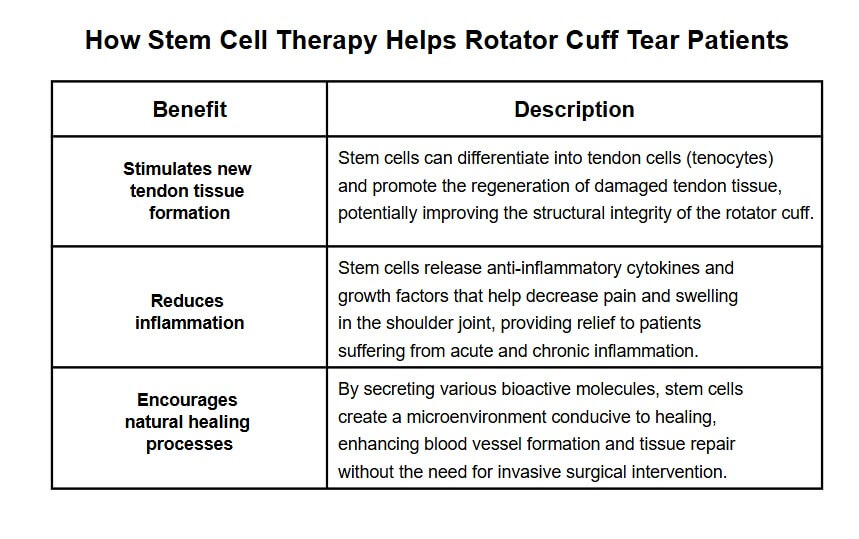
How Stem Cell Therapy Helps Rotator Cuff Tear Patients
- Stimulates new tendon tissue formation
- Reduces inflammation
- Encourages natural healing processes
Research shows that stem cell therapy may not fully heal a full-thickness tear but can significantly reduce pain, improve function, and, in some cases, even partially repair tendon tissue without surgery.
Studies on Stem Cell Treatment for Rotator Cuff Tears
- The Role Of Injections Of Mesenchymal Stem Cells As An Augmentation Tool In Rotator Cuff Repair: A Systematic Review (Published in JSES Reviews, Reports & Techniques, Volume 5, Issue 2, 231 – 242).
- Stem Cell Therapy for Rotator Cuff Injuries (Published in the Journal of Regenerative Medicine and Biology Research).
- Stem Cell Therapy In The Management Of Shoulder Rotator Cuff Disorders (Published in the World Journal of Stem Cells).
Platelet-Rich Plasma (PRP) Therapy

PRP therapy involves drawing a small amount of the patient’s blood, spinning it in a centrifuge to concentrate the platelets, and injecting the platelet-rich plasma into the torn rotator cuff.
PRP injections can help:
- Promote shoulder tissue repair
- Stimulate blood vessel formation around the injured rotator cuff
- Speed up healing
PRP is particularly effective for partial rotator cuff tears and tendinosis (chronic tendon degeneration). Doctors often turn to PRP injections when conservative measures have failed, but surgery isn’t yet necessary.
PRP Studies on Rotator Cuff Tear Treatment
Comparison of Clinical Outcomes after Platelet-Rich Plasma and Rotator Cuff Repair in High-Grade Intrasubstance Partial Rotator Cuff Tears (Published in the Journal of Clinical Medicine).
Effectiveness of platelet-rich plasma in partial-thickness rotator cuff tears: a systematic review (Published in Science Direct).
Treatment of Rotator Cuff Tears with platelet-rich plasma: a prospective study with 2-year follow‐up (Published by BMC Journal of Musculoskeletal Disorders).
When to Consider Regenerative Care for Rotator Cuffs
You might be a good candidate for regenerative treatment if:
- The tear is partial or associated with degenerative changes rather than acute trauma
- You want to avoid surgery
- You have persistent pain despite physical therapy and traditional treatments
- You’re seeking a faster recovery with lower risks than surgery
- You’ve tried conventional treatments with limited results
Start with a detailed evaluation with a pain management doctor experienced in regenerative techniques. Imaging, like MRI or ultrasound, can help determine the severity of the tear and guide treatment recommendations.
Book Non-Surgical Rotator Cuff Tear Treatment in Florida
Rotator cuff tears don’t always mean going under the knife. Non-surgical treatments, especially regenerative care options like stem cells and PRP, offer a powerful alternative for many patients, helping reduce pain, restore function, and potentially avoid the long recovery associated with surgery,
If you’re struggling with shoulder pain and wondering whether regenerative therapy could help, consider booking a free video consultation with STEMS Health in Miami Beach or call (305) 315-0815 to speak with our team urgently about your shoulder pain concerns.
Medical references:
Edwards P, Ebert J, Joss B, Bhabra G, Ackland T, Wang A. EXERCISE REHABILITATION IN THE NON-OPERATIVE MANAGEMENT OF ROTATOR CUFF TEARS: A REVIEW OF THE LITERATURE. Int J Sports Phys Ther. 2016 Apr;11(2):279-301. PMID: 27104061; PMCID: PMC4827371.
Poff G, Spencer E, Scott B, Sleadd R, Broyles J. Comparison of Clinical Outcomes after Platelet-Rich Plasma and Rotator Cuff Repair in High-Grade Intrasubstance Partial Rotator Cuff Tears. J Clin Med. 2023 Aug 26;12(17):5554. doi: 10.3390/jcm12175554. PMID: 37685621; PMCID: PMC10488403.
Prodromos CC, Finkle S, Prodromos A, Chen JL, Schwartz A, Wathen L. Treatment of Rotator Cuff Tears with platelet rich plasma: a prospective study with 2 year follow-up. BMC Musculoskelet Disord. 2021 May 29;22(1):499. doi: 10.1186/s12891-021-04288-4. PMID: 34051761; PMCID: PMC8164813.
