

Stem cell therapy for hair loss is increasingly marketed as a cutting-edge solution. While some regenerative treatments show early promise, most remain in research or pilot phases. Patients considering these therapies often encounter conflicting information and unclear expectations.
This article examines current science behind stem cell hair restoration, how treatments are administered, and how to distinguish evidence-based medicine from experimental claims.
Stem Cells for Hair Loss: The Approach and Expectations
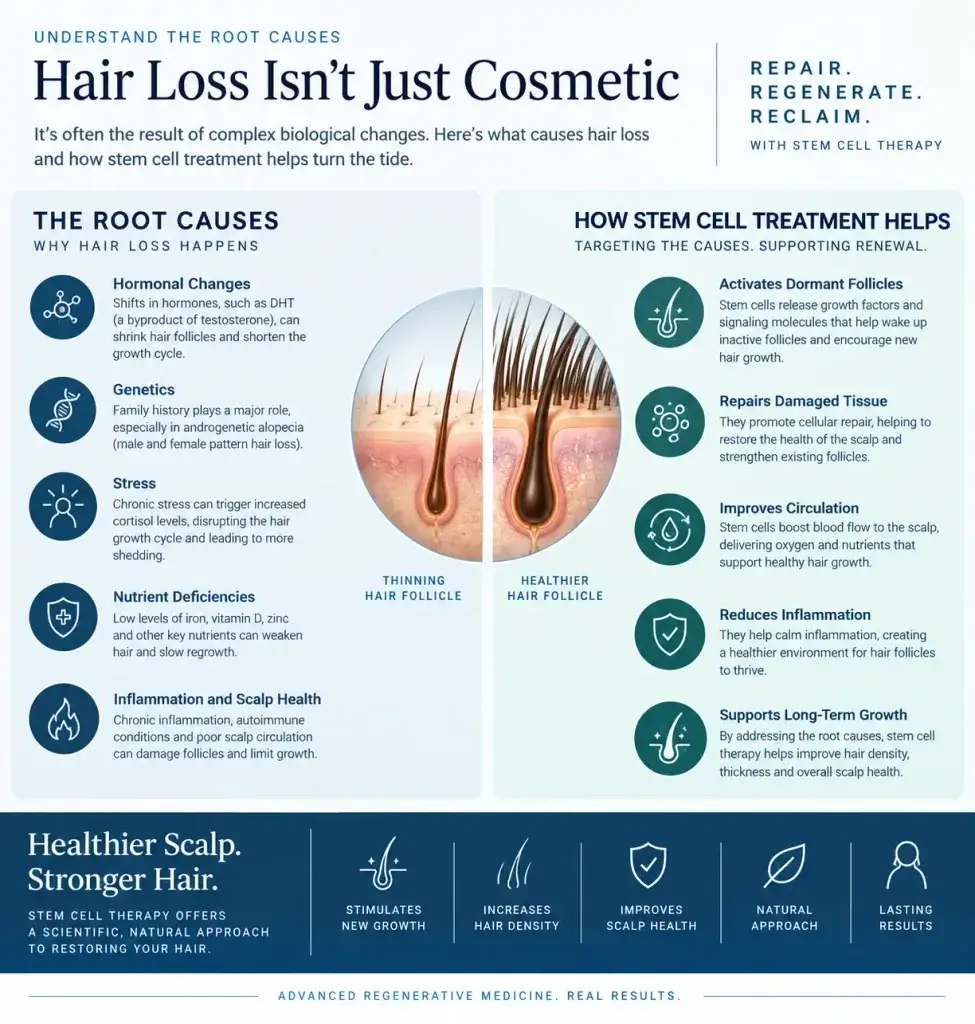
Stem cells are unspecialized cells capable of differentiating into various cell types, including those within hair follicles. In stem cell treatment for hair loss, the goal is to use these cells to stimulate miniaturized or dormant follicles affected by aging, genetics, or inflammation.
Most clinics use cell-derived products—such as conditioned media, platelet-rich plasma (PRP), or exosomes—instead of implanting live stem cells. Some protocols rely on a patient’s own fat tissue or bone marrow. These treatments aim to improve hair density, scalp health, and follicular activity, though outcomes vary based on individual factors and technique.
Stem Cell Alopecia Therapy: Techniques and Treatment Protocols
Stem cell alopecia therapy protocols differ across providers. The most common method draws adipose (fat) tissue from the patient, processes it to isolate mesenchymal stem cells, and injects the concentrate into the scalp. Many clinics combine injections with microneedling or low-level laser therapy to enhance delivery.
Autologous vs. Donor-Based Cells
Autologous treatments use the patient’s own cells, reducing risk of immune reactions. Donor-based (allogeneic) stem cells are primarily used in clinical research and are not yet a standard treatment. All approaches remain investigational and are not FDA‑approved for hair loss. Protocols often require multiple sessions over weeks or months and lack industry-wide standardization.
PRP and Stem Cells for Hair Loss: Exploring Combination Therapies
PRP is derived from the patient’s blood and is rich in growth factors that support tissue repair. When used with stem cell–derived compounds, the goal is to provide a broader regenerative signal.
- Enhanced follicle stimulation
- Improved scalp circulation
- Support for the extracellular matrix around hair follicles
These potential benefits are based mostly on observational data and anecdotal reports. Comparative clinical trials remain limited.
Stem Cell Therapy Vs. Other Hair Loss Treatment Options
| Treatment Option | Estimated Cost | Recovery Time | Availability | Scientific Proof |
| Stem Cell Therapy | $3,000 – $20,000 per session | Minimal 1-2 days of mild scalp tenderness or swelling. | Limited Only available at specialized regenerative medicine clinics. Often considered experimental. | Emerging Early clinical trials show promising increases in hair density. Not FDA-approved for hair loss. |
| Minoxidil (Topical) (e.g., Rogaine) | $5 – $40 per month | None Applied topically at home. | Wide Over-the-counter at most pharmacies and online. | Strong FDA-approved. Decades of clinical data proving its efficacy in prolonging the hair growth phase (anagen) and increasing follicle size. |
| Finasteride (Oral) (e.g., Propecia) | $10 – $30 per month | None Daily oral pill taken at home. | Wide Requires a doctor’s prescription. | Strong FDA-approved for men. Extensive long-term clinical data show it effectively halts hair loss by blocking the DHT hormone. |
| Hair Transplant (FUE or FUT Surgery) | $4,500 – $40,000 total | Moderate 1 to 2 weeks for scabs to heal and redness to subside. | Wide Available globally through specialized hair restoration surgeons. | Strong The clinical gold standard for replacing hair in completely bald areas. High success rate with permanent, proven results. |
| Platelet-Rich Plasma (PRP) | $1,500 – $3,500 for the initial series | Minimal 1-2 days of scalp tenderness from injections. | Wide Offered at most dermatology and hair restoration clinics. | Moderate Numerous studies demonstrate increased hair count and thickness. However, it lacks a standardized preparation protocol, so results can vary significantly between clinics. |
Hair Regeneration Stem Cell Therapy: Early Study Results
Stem cell hair restoration is an emerging regenerative therapy that utilizes stem cells—often derived from adipose (fat) tissue, bone marrow, or the hair follicles themselves—to stimulate dormant follicles, increase hair density, and reduce scalp inflammation.
Recent clinical trials and systematic reviews have investigated these therapies, which range from topically applied stem cell extracts to direct scalp injections. The research primarily focuses on treating conditions like androgenetic alopecia (common pattern baldness) and alopecia areata (autoimmune hair loss).
Here are the key findings from recent peer-reviewed studies:
Topical Adipose-Derived Stem Cell Extracts (Tak et al., 2020)
- What the study involved: A 16-week randomized, double-blind, vehicle-controlled clinical trial involving 38 patients with androgenetic alopecia. The intervention group applied a topical solution made of an adipose-derived stem cell constituent extract (ADSC-CE) to their scalps twice daily.
- What the results showed: The stem cell extract group achieved a 28.1% increase in hair count, compared to a 7.1% increase in the placebo control group. Additionally, hair diameter (thickness) significantly improved by 14.2% versus 6.3% in the control group, demonstrating that topical stem cell extracts can effectively increase both density and thickness.
Systematic Review of Stem Cell Therapies (Gasteratos et al., 2024)
- What the study involved: A comprehensive systematic review analyzing 12 randomized controlled trials published between 2013 and 2023. The review evaluated both cellular and acellular stem cell therapies (harvested from adipose tissue, hair follicles, bone marrow, and umbilical cord blood) for managing androgenetic alopecia.
- What the results showed: The aggregated data demonstrated that stem cell-derived treatments are safe and consistently promote hair regeneration and increase hair density. However, the authors noted that outcomes can sometimes be temporary, suggesting these regenerative therapies may be most effective when used as adjuncts alongside traditional hair transplantation methods.
Injectable Stem Cells for Autoimmune Hair Loss (Deng et al., 2021)
- What the study involved: An in vivo and in vitro laboratory study focusing on alopecia areata (an autoimmune disease that causes patchy hair loss). Researchers injected hair follicle-derived mesenchymal stem cells (HF-MSCs) into a mouse model of the disease once a week for three weeks.
- What the results showed: The stem cell injections significantly decreased hair loss in the subjects. Cellular profiling revealed that the stem cells successfully reduced inflammation around the hair follicles. This indicates that stem cells may help suppress the localized autoimmune attacks that cause alopecia areata, offering an alternative to traditional corticosteroid treatments.
Book Stem Cell Therapy for Hair Restoration in the U.S. with STEMS Health Miami
At STEMS Health, board-certified physicians complete all hair loss stem cell treatments. We focus on transparent protocols, diagnostic imaging, and evidence‑based treatments. If you’re considering regenerative options, request a personalized stem cell hair treatment consultation to explore whether these therapies align with your goals and medical profile.
FAQs on Stem Cell Hair Loss Therapy
What types of stem cells are used for hair loss treatments?
Most therapies use mesenchymal stem cells derived from a patient’s fat (adipose tissue) or bone marrow. These cells are processed and injected into the scalp to potentially stimulate follicle health.
Do any stem cell treatments have FDA approval for hair loss?
No. Currently, stem cell therapies for hair loss are considered experimental and are not FDA-approved. Many are offered off-label or under clinical trial protocols.
How do stem cell therapies differ from PRP for hair restoration?
PRP uses concentrated platelets from the patient’s blood to promote healing. Stem cell therapies aim to support follicular regeneration through broader regenerative signaling, including growth factors and cytokines.
When might someone see results from stem cell hair therapy?
Results usually take place over several months following two or three treatment sessions. Outcomes vary depending on the degree of hair loss, patient age, and the specific treatment protocol used.
Is stem cell therapy a permanent solution for hair loss?
Stem cell treatments are not currently considered permanent. Maintenance sessions may be required, and outcomes differ among individuals. Regular follow-up with a hair restoration specialist is recommended.
Who is a good candidate for stem cell hair treatments?
The ideal candidate is someone in the early to moderate stages of hair loss with active but miniaturized (dormant) hair follicles. It is highly effective for both male and female pattern baldness.
Can stem cell therapy regrow hair on completely bald areas?
No. If a hair follicle is completely dead and the scalp tissue has scarred over, stem cells cannot generate a brand-new follicle from scratch. A traditional hair transplant is required for completely bald spots.
Is stem cell hair therapy effective for women?
Yes. In fact, it is often highly recommended for women experiencing diffuse thinning (female pattern hair loss), as women are frequently not ideal candidates for traditional hair transplant surgery.
How are the stem cells physically harvested?
Usually, a doctor performs a “mini-liposuction” under local anesthesia to remove a small amount of fat tissue (adipose) from the patient’s abdomen, flank, or thigh. Alternatively, some procedures extract a small punch biopsy from the scalp.
How long does the stem cell procedure take?
The entire outpatient process—including harvesting the fat, centrifuging and purifying the cells in an on-site lab, and injecting them into the scalp—typically takes between 2 and 3 hours.
Is the procedure painful?
Discomfort is minimal. Local anesthesia (and sometimes mild sedation) is used during both the fat extraction and the scalp injections to ensure a relatively painless experience.
What is the recovery time like?
There is virtually no downtime. Most patients can drive themselves home (unless sedated) and return to normal activities the next day. However, strenuous exercise should be avoided for about a week.
Are there risks of allergic reaction or tissue rejection?
When using autologous stem cells (cells harvested from your own body), the risk of tissue rejection or an allergic reaction is essentially zero because the body recognizes its own biological material.
What are the potential side effects?
Side effects are generally mild and temporary. Patients may experience slight redness, bruising, swelling, or tenderness at both the donor site (where fat was removed) and the injection sites on the scalp for 1 to 2 days.
What are exosomes, and how are they different?
Exosomes are messenger particles secreted by stem cells that contain powerful growth factors. Some clinics inject lab-derived exosomes instead of harvesting a patient’s fat, functioning as a cell-free alternative to stimulate the follicles.
How many treatment sessions are typically needed?
Depending on the severity of the hair loss, most patients undergo 1 to 3 initial sessions. Because hair loss is progressive, yearly or bi-annual maintenance sessions are often recommended.
Can stem cell therapy be combined with a hair transplant?
Yes. Many hair restoration surgeons inject stem cells during or immediately after an FUE or FUT transplant to improve graft survival, speed up tissue healing, and stimulate the surrounding native hair.
Should I stop using Minoxidil or Finasteride during treatment?
Generally, no. Most doctors advise patients to continue their FDA-approved topical or oral medications, as they work synergistically with stem cells to protect hair from hormonal shedding while the stem cells repair the follicles.
How soon can I wash my hair after the procedure?
Doctors usually advise waiting at least 24 to 48 hours before washing the scalp or applying any styling products to allow the micro-injection sites to heal and prevent infection.
Does health insurance cover stem cell therapy for hair loss?
No. Because it is considered an elective cosmetic procedure and is still classified as experimental by the FDA, it is strictly an out-of-pocket expense.
Why do some clinics offer stem cells from umbilical cords?
Some providers use “allogeneic” stem cells derived from donated umbilical cord blood or tissue. While rich in growth factors, introducing foreign genetic material carries different regulatory scrutiny and slightly different safety profiles than using your own body fat.
How do stem cells physically reverse hair miniaturization?
When injected, the cells release paracrine signaling molecules, cytokines, and growth factors. These signals increase blood flow to the follicle, reduce inflammation, and push the hair back into the anagen (active growth) phase.
Are stem cell hair treatments legal?
Yes, they are legal when performed by licensed physicians in sterile medical environments. However, providers must adhere to strict FDA guidelines regarding the “minimal manipulation” of a patient’s own tissue, as the procedure is still off-label.
What happens if I stop getting maintenance treatments?
Because androgenetic alopecia (pattern baldness) is driven by genetics and hormones, stopping all regenerative maintenance therapies will likely result in the hair follicles slowly miniaturizing and thinning again over time.
How do I choose a safe and effective clinic?
Look for board-certified dermatologists or plastic surgeons who clearly explain their extraction methods, maintain strict sterile processing in their labs, openly discuss the risks, and have verifiable before-and-after portfolios.
References:
Deng, W., Zhang, Y., Wang, W., et al. (2021). Hair follicle-derived mesenchymal stem cells decrease alopecia areata mouse hair loss and reduce inflammation around the hair follicle. Stem Cell Research & Therapy, 12. https://doi.org/10.1186/s13287-021-02614-0
Gasteratos, K., Kouzounis, K., & Goverman, J. (2024). Autologous Stem Cell-derived Therapies for Androgenetic Alopecia: A Systematic Review of Randomized Controlled Trials on Efficacy, Safety, and Outcomes. Plastic and Reconstructive Surgery – Global Open, 12, e5606. https://doi.org/10.1097/gox.0000000000005606
Tak, Y. J., Lee, S. Y., Cho, A. R., & Kim, Y. S. (2020). A randomized, double-blind, vehicle-controlled clinical study of hair regeneration using adipose-derived stem cell constituent extract in androgenetic alopecia. Stem Cells Translational Medicine, 9(8), 839–849. https://doi.org/10.1002/sctm.19-0410
