

Recent data shows meniscus tears are more common than previously thought, with studies showing 222 meniscus tears per 100,000 people aged 18 to 55. Traditionally, arthroscopic surgery has been the primary treatment for symptomatic meniscus tears, particularly when conservative care fails. Arthroscopy includes either a meniscectomy (removing the torn portion of the meniscus) or a meniscus repair (suturing the tissue back together).
However, surgical removal of the meniscus can accelerate cartilage wear, increase knee instability, and raise the long-term risk of osteoarthritis. Even meniscus repairs, while joint-preserving, are not always possible depending on the type and location of the tear.
Stem cell therapy for meniscus tears, and associated biologic treatments are a promising alternative for promoting natural repair, reducing pain, and improving function, often without the downtime, risks, or permanent tissue loss associated with surgery.
Many are now asking: “Can biologics replace arthroscopic surgery for meniscus tears?”
Understanding the Healing Challenges Associated with Meniscus Tears
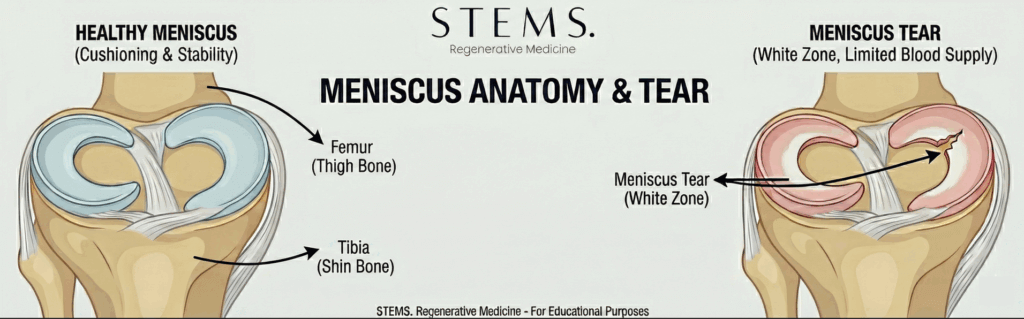
The meniscus is a crescent-shaped cartilage structure that cushions and stabilizes the knee joint. Each knee has a medial and a lateral meniscus, both of which are essential for absorbing shock and reducing stress on the bones.
The challenge with meniscus injuries lies in the blood supply:
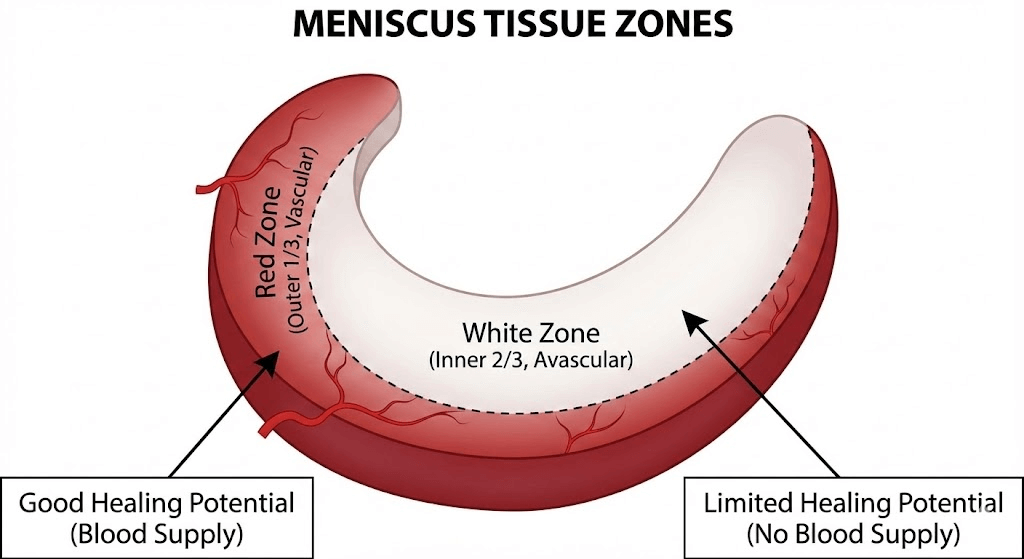
As a result, many tears, especially those in the white zone, are traditionally treated with partial tissue removal, which can cause long-term joint deterioration.
Stem cell therapy uses the body’s own regenerative cells. These cells possess the ability to:
- Differentiate into various tissue types, including fibrocartilage.
Potentially, stem cells can regenerate meniscus tissue, restoring structural integrity and cushioning in the knee.
- Modulate inflammation, which reduces pain and promotes a healing environment.
Chronic inflammation from a torn meniscus contributes to pain and stiffness. Stem cells can help reduce inflammation, with noticeable pain relief and improved joint function.
- Release growth factors that stimulate local tissue repair.
Growth factors encourage surrounding meniscus and cartilage cells to repair and regenerate, enhancing long-term knee health and supporting functional recovery.
When injected into the knee, often guided by ultrasound or fluoroscopy, stem cells target areas of damage, reduce inflammation in the joint, and encourage natural repair mechanisms. In some cases, doctors combine stem cells with PRP (platelet-rich plasma) to improve growth factor delivery.
Patient Spotlight: Adam Frater’s Meniscus Tear Recovery with Stem Cell Therapy at STEMS Health
Showcasing the individual patient journey can help you further understand the benefits of stem cell meniscus tear treatment. Adam Frater, a calisthenics athlete and founder of Project Shred, faced severe knee pain due to a torn meniscus and turned to STEMS Health when he was experiencing limited mobility.
Previously, doctors recommended surgery, warning of a long recovery and permanent changes. Adam sought a less invasive solution.
He turned to STEMS Health and consulted with Dr. Ankeet Choxi, one of the clinic’s founders and a national leader for stem cell athletic treatment. Dr. Choxi evaluated Adam’s knee using ultrasound to pinpoint the exact areas of meniscal damage. He provided a detailed treatment and recovery plan, explaining how stem cells could harness Adam’s body’s natural healing processes to repair the meniscus without undergoing surgery.
Adam underwent bone marrow-derived stem cell injections, which were processed and precisely injected into the injured areas of his knee under ultrasound guidance. The minimally invasive procedure allowed him to resume light activities immediately.
Within months, Adam experienced significant reductions in pain, improved knee flexibility, and enhanced mobility. The regenerative effects of the stem cell therapy continued to support his physical capabilities. Therapy helped Adam return to his peak athletic performance while avoiding surgery.
Adam’s case highlights stem cell therapy as an effective, non-surgical solution for meniscus injuries.
When Are Stem Cells Most Effective for Meniscus Tears?
Stem cell therapy is not a universal replacement for surgery, but as Adam Frater’s case shows, it can be highly effective in certain scenarios. Patients who benefit most often fall into the following categories:
 Degenerative Meniscus Tears
These often occur in middle-aged or older adults and develop gradually. Surgery for degenerative tears rarely offers long-term benefit, making biologics a valuable alternative.
Stable Tears Without Mechanical Locking
Patients with pain, swelling, or limited movement—but without knee locking—tend to respond well to injections.
Tears in the White Zone
Stem cells can help overcome the limited blood supply that prevents natural healing.
Patients Hoping to Avoid or Delay Surgery
Biologics may provide relief and functional improvement without eliminating meniscal tissue.
Early Osteoarthritis With Meniscus Damage
Stem cells can support both cartilage and meniscus health, addressing multiple joint problems simultaneously.
Can Stem Cells Heal the Meniscus Completely?
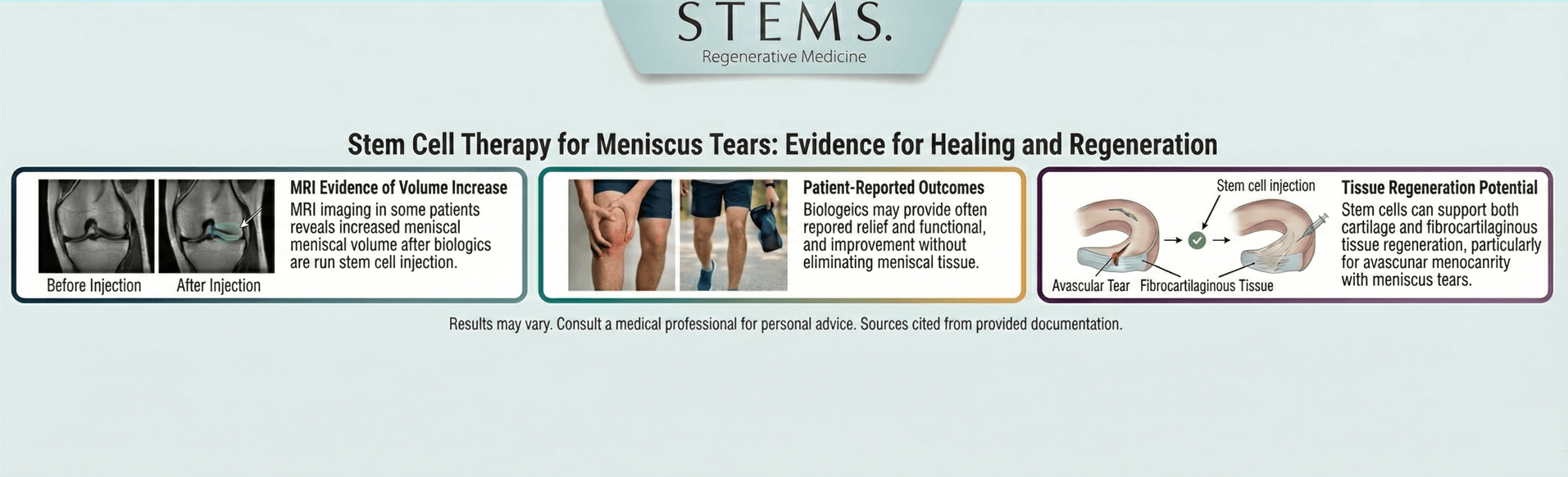
Research on stem cell therapy for meniscus tears is ongoing. But several studies show promise:
- MRI imaging in some patients reveals increased meniscal volume after stem cell injection.
- Meniscus tear patients often report reduced pain, less swelling, and improved knee function.
- Some studies show stem cells may promote fibrocartilaginous tissue regeneration, particularly for avascular meniscus tears.
While stem cells may not always support complete anatomic healing, biologics can reduce pain, improve function, and optimize the joint environment, which is the ultimate goal for most patients.
When Arthroscopic Surgery Is Still Necessary
While biologics are advancing rapidly, surgery remains the best option in certain circumstances.
Mechanical Locking or Catching
A displaced flap or bucket-handle tear that causes the knee to lock typically needs surgical intervention.
Tears That Are Unstable and Won’t Heal on Their Own
Some patterns, including complex radial tears, may require surgical repair.
Severe Root Tears
These tears act like a complete meniscectomy if not repaired and often need surgical fixation.
Patients Expecting High-Demand Athletic Performance
Some athletes require surgical repair for structural stability.
The Advantages of Stem Cell and Biologic Treatment
1. No Tissue Removal
Preserving the meniscus protects long-term joint health.
2. Lower Risk Compared to Surgery
No anesthesia, no incisions, and lower risk of complications.
3. Faster Recovery Time
Most patients resume normal activities quickly, with minimal downtime.
4. Reduced Inflammation
Biologics help calm chronic inflammation that contributes to knee pain.
5. Potential Regeneration, Not Just Removal
Unlike surgery, biologics aim to repair rather than remove tissue.
Can Biologics Eventually Replace Surgery?
For many meniscus tears, especially degenerative or partial tears, the answer is trending toward yes. Regenerative medicine is becoming the preferred option for individuals who want to avoid tissue removal, preserve joint health, or try a less invasive treatment first.
Most experts agree that the future of meniscus treatment will involve a hybrid approach, using surgery only when structurally necessary and biologics for healing support and long-term joint preservation.
Schedule Your Knee Pain Consultation with STEMS Health in Miami
Patients with knee pain across the country are now choosing STEMS Health for comprehensive pain analysis and tailored knee pain relief programs. Board-certified doctors, Dr. Ankeet Choxi and Dr. Jarred Mait, have completed over 10,000 pain-relief treatments with biologics and can help guide your journey toward lasting knee pain relief.
Schedule a free consultation with STEMS Health today to discover whether biologics are the right choice for you.
FAQ: Stem Cell Therapy for Meniscus Tears
1. Does stem cell therapy heal the meniscus completely?
Not always. It can improve tissue quality, reduce inflammation, and enhance function. Full structural restoration varies depending on the type and severity of the meniscus tear.
2. Is stem cell therapy painful?
Most patients tolerate the procedure well. Mild soreness after injection is common and usually resolves within a few days.
3. How long does it take to see improvement?
Some patients notice relief within weeks, while others experience progressive improvement over 3–6 months.
4. Can stem cells treat a meniscus tear pain without surgery?
Yes, especially for degenerative tears, stable tears, and tears in the avascular “white zone.”
5. What is the success rate?
While results vary, many patients report significant pain reduction, improved function, and better long-term outcomes compared to surgery for degenerative tears.
6. Can I avoid knee replacement with biologics?
For some patients, stem cells and PRP can reduce pain and delay or avoid the need for joint replacement, especially when cartilage damage is mild to moderate.
7. Are biologics safe?
Yes. Because they use the patient’s own cells, the risks of rejection or allergic reaction are very low.
