

You’ve had the MRI. Your discs look “age-appropriate.” You’ve done the stretches, the physical therapy, and maybe a round of anti-inflammatories, but the ache low in your back and deep in your buttock keeps coming back. Sitting through a long dinner is uncomfortable. Getting out of the car hurts. Rolling over in bed wakes you up.
For many people, the problem isn’t the spine. It’s the sacroiliac (SI) joint, one of the most overlooked sources of chronic lower back pain. Here’s what SI joint dysfunction is, why it’s so often missed, and where regenerative treatments like PRP and stem cell therapy fit among your options.
What Is the SI Joint?
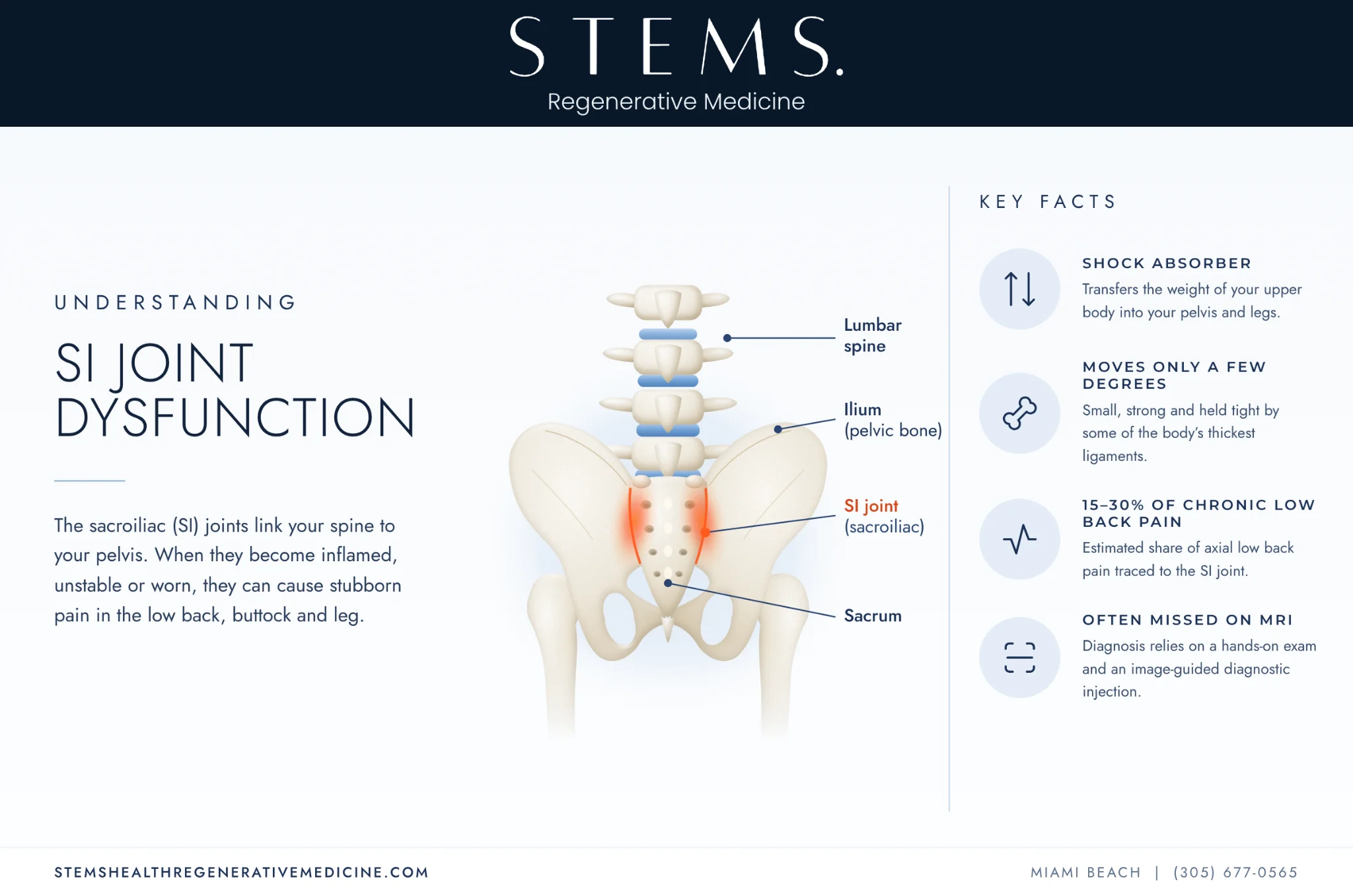
You have two SI joints, one on each side of your lower back. Each one connects the sacrum, the triangular bone at the base of your spine, to the ilium, the large wing-shaped bone of your pelvis. You can usually find them under the two dimples just above your buttocks.
Unlike your knee or shoulder, the SI joint barely moves, only a few degrees. Its job is to absorb shock and transfer the weight of your upper body into your pelvis and legs. It’s held together by some of the strongest ligaments in the body. When those ligaments are strained, the cartilage wears down, or the joint moves too much or too little, the result is SI joint dysfunction.
How Common Is SI Joint Pain?
More common than most people realize. A comprehensive review in Expert Review of Neurotherapeutics estimates the SI joint is the main pain source in roughly 15% to 30% of people with chronic axial low back pain.
The numbers are even higher after spine surgery. In a study of patients with persistent pain after lumbar fusion, the SI joint was the most likely source in 43% of cases. Fusing the lower spine can shift extra load onto the SI joints below it.
Common Causes and Risk Factors
- Wear and tear. Cartilage in the joint thins with age, just like in the hips and knees.
- Injury. A fall onto the buttock, a car accident, or a hard landing can sprain the joint’s ligaments.
- Prior lumbar fusion. Extra stress transfers to the SI joints.
- Pregnancy and childbirth. Hormones loosen the pelvic ligaments, and the joint may not fully stabilize afterward.
- Leg-length differences or an altered gait. Uneven loading wears one side faster.
- Repetitive sports. Running, golf, tennis, and other one-sided rotational sports stress the pelvis.
- Inflammatory arthritis. Conditions such as ankylosing spondylitis can target the SI joints (these need a rheumatology workup).
SI Joint Dysfunction Symptoms
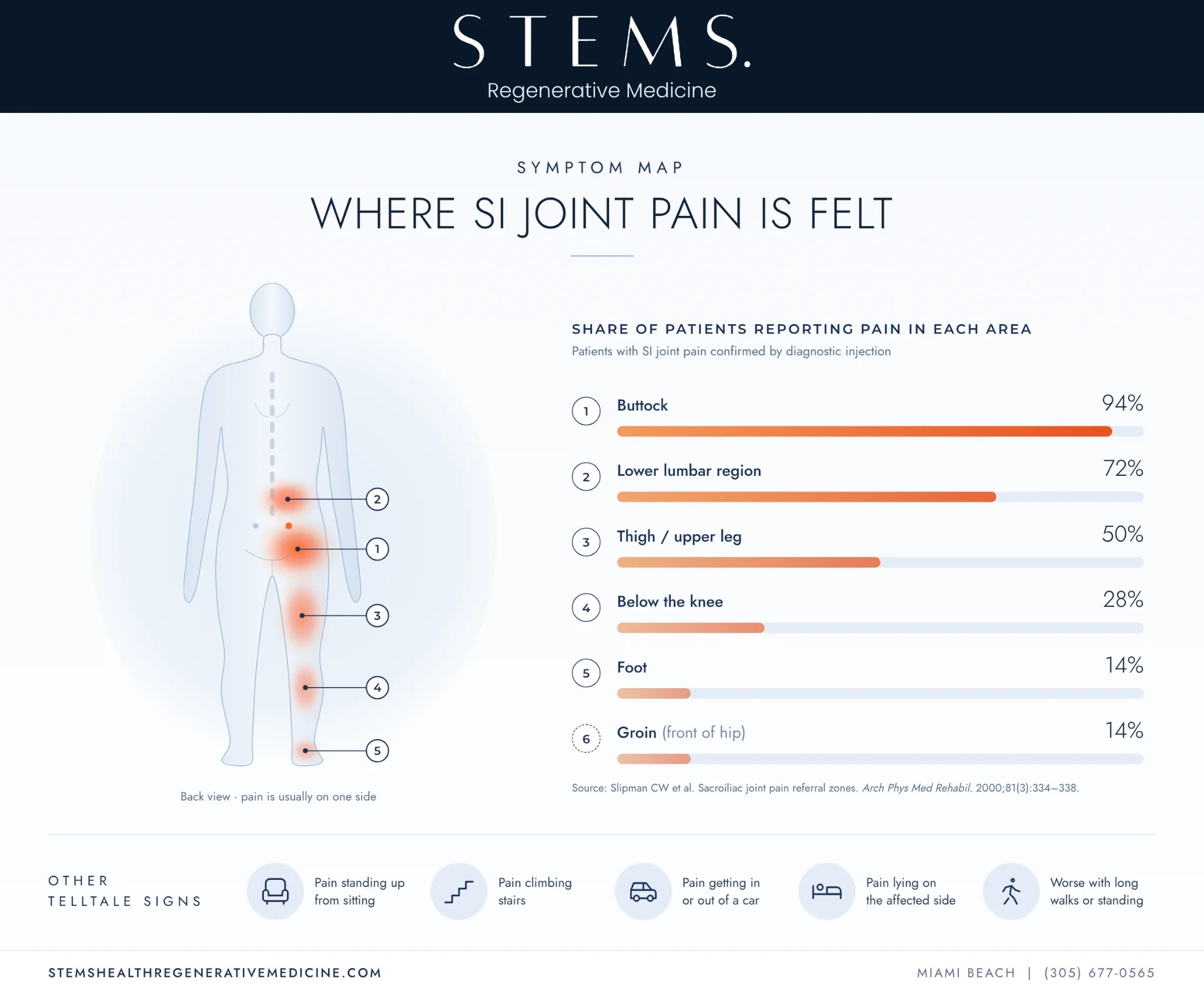
SI joint pain is a great imitator. It can feel like a herniated disc, sciatica, or a hip problem. In a classic study of SI joint pain referral patterns, 94% of patients felt pain in the buttock, 72% in the lower lumbar region, and 50% in the leg. About 28% had pain below the knee, and 14% felt it in the groin or foot.
Other telltale signs include:
- Pain on one side, just below the belt line
- Pain when standing up from sitting, climbing stairs, or getting out of a car
- Discomfort sleeping on the affected side
- Pain that worsens with standing on one leg or long walks
- Stiffness in the low back and pelvis in the morning
Why SI Joint Pain Is Often Missed
X-rays and MRIs often look normal, or they show disc changes that may have nothing to do with your pain. Diagnosis relies on a careful exam. Research on provocation tests shows that no single test is reliable alone, but three or more positive results out of a cluster of five hands-on tests strongly point to the SI joint.
The gold standard is a diagnostic injection: numbing medicine placed in the joint under image guidance. If your pain drops significantly, the SI joint is very likely the culprit. At STEMS Health, our physicians use ultrasound or fluoroscopic guidance so treatment goes exactly where it’s needed.
Traditional Treatment Options
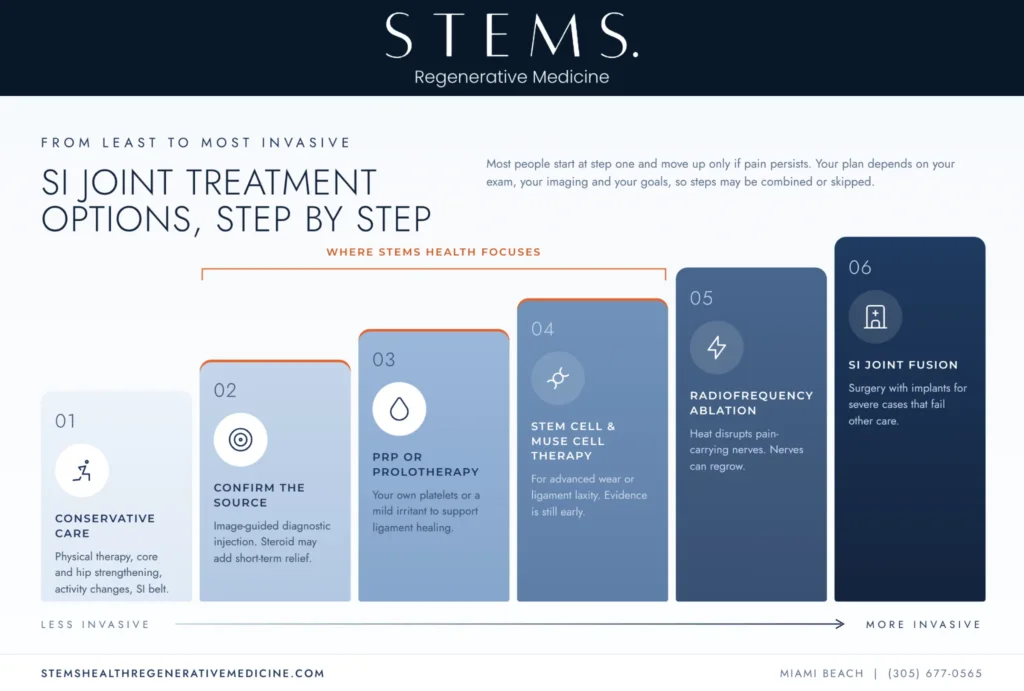
Most people start with conservative care: activity changes, anti-inflammatory medication, physical therapy focused on core and hip strength, and sometimes an SI belt. When that isn’t enough, the usual next steps are:
- Corticosteroid injections. These calm inflammation and can bring fast relief, but the effect often fades over weeks to months, and repeated steroid exposure has drawbacks.
- Radiofrequency ablation. Heat is used to disrupt the small nerves that carry pain signals from the joint. Nerves can regrow, so relief may be temporary.
- SI joint fusion surgery. Implants lock the joint in place. It’s an option for severe cases, but it’s surgery, with recovery time and risks.
How Stem Cells and MuseCells May Help Relieve SI Joint Pain
SI joint dysfunction is rarely one problem. The ligaments that lock the joint together can stretch and loosen, the thin layer of cartilage on the joint surfaces can wear down, and the joint capsule can stay inflamed for months. Steroids quiet the inflammation for a while, radiofrequency ablation silences the nerves, and fusion locks the joint in place. None of them treats the tissue itself. That gap is why patients with stubborn SI joint pain ask about cell-based therapy.
Stem cell therapy for the SI joint
During stem cell therapy for the SI joint, cells are placed under ultrasound or fluoroscopic guidance into the joint and along the posterior sacroiliac ligaments that hold it stable. Rather than becoming new tissue themselves, the cells act as signaling centers. They release proteins that calm inflammation and help direct the body’s repair of ligament and cartilage. For the SI joint, the potential benefits include:
- Less inflammation inside the joint capsule, without repeated steroid exposure
- Support for loose, stretched ligaments, the main problem in a hypermobile SI joint after pregnancy, a fall, or years of one-sided sports
- Support for worn cartilage in a joint with degenerative changes
- Treating the joint and its ligaments in one visit, on one or both sides
- A nonsurgical step before ablation or fusion, including for SI pain that develops after a lumbar fusion
Published research on stem cells in the SI joint is still limited to small reports. Most of the evidence comes from larger joints such as the knee and hip, so we’re clear with patients about what is proven and what is promising.
Dezawa MuseCell® therapy for the SI joint
Dezawa MuseCells® (multilineage-differentiating stress-enduring cells) were first identified in 2010 in bone marrow and connective tissue. These cells survive stressful conditions that destroy many other cells and can develop into a wide range of cell types.
That versatility matters in the SI joint, where cartilage, bone, and dense ligament sit side by side. In an animal study of joint-surface defects, MuseCells® helped rebuild both the cartilage and the bone beneath it. STEMS Health is an authorized Dezawa MuseCell® provider.
Who May Be a Good Candidate?
You may want to explore regenerative care if:
- A diagnostic block confirmed your SI joint as the pain source
- Steroid injections helped, but only for a few weeks
- You want to avoid or delay radiofrequency ablation or fusion
- You have pain in the SI joint after a previous lumbar fusion
- You’re active and want to get back to running, golf, or tennis
Regenerative treatments are not right for everyone. Inflammatory arthritis, infection, fractures, and some blood disorders need different care.
Your SI Joint Pain Consultation at STEMS Health
Your visit starts with a detailed history and exam with one of our physicians, Dr. Ankeet Choxi or Dr. Jarred Mait. We review your imaging, confirm the source of your pain, and talk honestly about which options make sense. Injections are image-guided and completed in our Miami Beach office, and most patients walk out the same day.
Answer to Your Questions on SI Joint Pain Relief and Regenerative Medicine
What does SI joint pain feel like?
Most people describe a dull or sharp ache on one side of the low back, just below the belt line, often spreading into the buttock or the back of the thigh.
Can SI joint pain cause sciatica-like symptoms?
Yes. SI joint pain can radiate down the leg and mimic sciatica, though true nerve compression tends to cause numbness or tingling below the knee.
Is SI joint pain the same as hip pain?
No, but they overlap. Hip joint pain is usually felt in the groin, while SI joint pain is usually felt in the low back and buttock.
Will an MRI show SI joint dysfunction?
Often not. MRI can show inflammation or arthritis, but mechanical SI joint dysfunction usually requires a physical exam and a diagnostic injection.
How many PRP injections will I need for my SI joint?
Many patients need one to three treatments, spaced several weeks apart. Your physician will tailor the plan to your response.
How long does it take to feel results after PRP?
PRP works gradually. Many patients notice changes within four to eight weeks, with continued improvement over several months.
Can I have PRP if I’ve already had steroid injections?
Yes. Your physician will usually wait several weeks after a steroid injection before PRP.
Can regenerative treatment help after a lumbar fusion?
It may. SI joint pain after fusion is common, and regenerative care can be considered once your surgeon clears you.
Do I need to stop physical therapy?
No. Physical therapy that builds core, glute, and hip strength works hand in hand with regenerative treatment.
Is treatment covered by insurance?
Regenerative treatments usually aren’t covered by insurance. Ask us about financing options.
Diagnose and Relieve SI Joint Pain with STEMS Health

If your low back pain has never been fully explained, it may be time for fresh analysis. Schedule a consultation with STEMS Health Regenerative Medicine in Miami Beach or call (305) 677-0565. We’ll pinpoint the source of your pain and build a plan around your goals.
References
- Cohen SP, Chen Y, Neufeld NJ. Sacroiliac joint pain: a comprehensive review of epidemiology, diagnosis and treatment. Expert Rev Neurother. 2013;13(1):99-116.
- DePalma MJ, Ketchum JM, Saullo TR. Etiology of chronic low back pain in patients having undergone lumbar fusion. Pain Med. 2011;12(5):732-739.
- Slipman CW, Jackson HB, Lipetz JS, et al. Sacroiliac joint pain referral zones. Arch Phys Med Rehabil. 2000;81(3):334-338.
- Laslett M, Aprill CN, McDonald B, Young SB. Diagnosis of sacroiliac joint pain: validity of individual provocation tests and composites of tests. Man Ther. 2005;10(3):207-218.
- Singla V, Batra YK, Bharti N, Goni VG, Marwaha N. Steroid vs. platelet-rich plasma in ultrasound-guided sacroiliac joint injection for chronic low back pain. Pain Pract. 2017;17(6):782-791.
- Wallace P, Bezjian Wallace L, Tamura S, et al. Effectiveness of ultrasound-guided platelet-rich plasma injections in relieving sacroiliac joint dysfunction. Am J Phys Med Rehabil. 2020;99(8):689-693.
- Chen AS, Solberg J, Smith C, et al. Intra-articular platelet-rich plasma vs corticosteroid injections for sacroiliac joint pain: a double-blind randomized clinical trial. Pain Med. 2022;23(7):1266-1271.
- Kim WM, Lee HG, Jeong CW, Kim CM, Yoon MH. A randomized controlled trial of intra-articular prolotherapy versus steroid injection for sacroiliac joint pain. J Altern Complement Med. 2010;16(12):1285-1290.
- Ko GD, Mindra S, Lawson GE, et al. Case series of ultrasound-guided platelet-rich plasma injections for sacroiliac joint dysfunction. J Back Musculoskelet Rehabil. 2017;30(2):363-370.
- Kuroda Y, Kitada M, Wakao S, et al. Unique multipotent cells in adult human mesenchymal cell populations. Proc Natl Acad Sci USA. 2010;107(19):8639-8643.
- U.S. Food and Drug Administration. Important patient and consumer information about regenerative medicine therapies.
