

The ache starts in your groin or the front of your thigh. Putting on socks gets harder. Golf, tennis, or a long walk on the beach leaves you limping the next day. Then an X-ray shows arthritis, and your doctor mentions the words “hip replacement.”
For some people, surgery is the right answer. For many others, especially those with mild to moderate arthritis, it isn’t the only one. Here’s what’s happening inside an arthritic hip, how nonsurgical options compare, and where regenerative treatments like PRP and stem cell therapy may fit.
What is the Cause of Hip Arthritis?
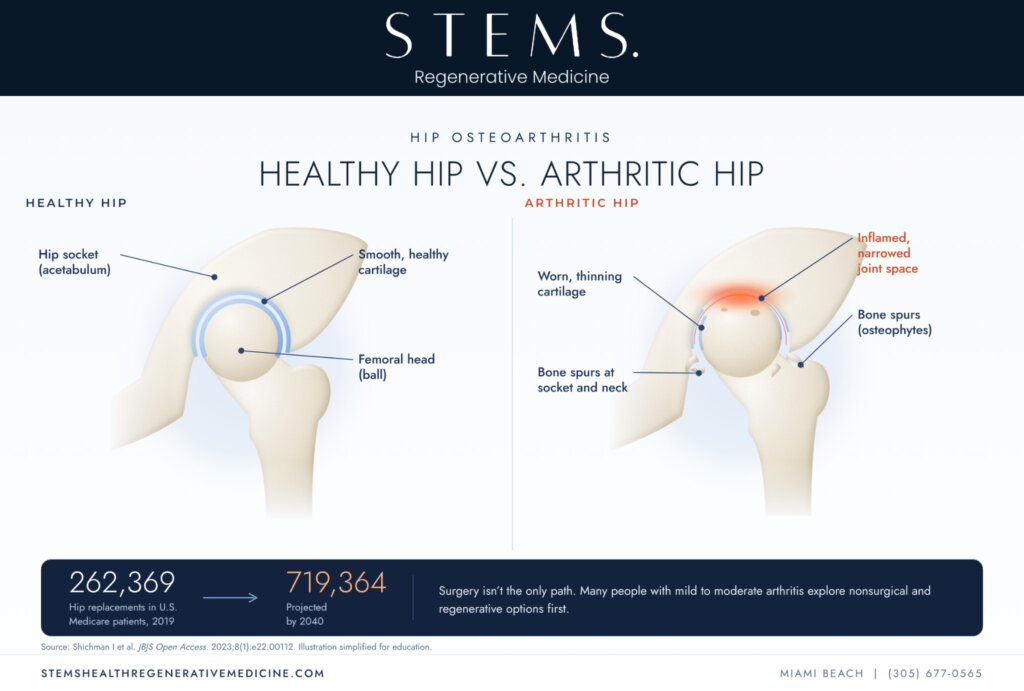
Your hip is a ball-and-socket joint. The ball (femoral head) sits in a cup in your pelvis called the acetabulum. Both surfaces are covered with smooth cartilage that lets the joint glide.
In osteoarthritis, that cartilage gradually wears thin. The joint space narrows, the lining becomes inflamed, and the body may form bone spurs around the edges. The result is pain, stiffness, and lost range of motion, often felt in the groin, thigh, buttock, or even the knee.
Why People Look for Alternatives to Hip Replacement
Hip replacement is one of the most common operations in the country. Research in JBJS Open Access counted more than 262,000 primary hip replacements in U.S. Medicare patients in 2019 and projects about 719,000 a year by 2040.
It’s a reliable operation, but it’s still major surgery. People look for alternatives because they:
- Are younger and worried about an implant wearing out
- Want to avoid hospital stays, anesthesia, and weeks of rehab
- Have medical conditions that raise surgical risk
- Have mild or moderate arthritis that isn’t ready for replacement
- Simply want to stay active and delay surgery as long as possible
Traditional Nonsurgical Options
Most treatment plans begin with the basics: weight management, physical therapy to strengthen the glutes and core, low-impact exercise, activity changes, and anti-inflammatory medication.
Cortisone injections are the next common step. They calm inflammation and often bring fast relief. The trade-off is that relief usually fades within weeks to a few months, and a review in Radiology raised concerns about joint damage after repeated steroid injections in the hip and knee. Learn more in our guide to stem cells vs. cortisone injections.
Hyaluronic acid (gel) injections aim to improve joint lubrication, though the evidence for the hip is mixed.
Regenerative Alternatives to Hip Replacement
Regenerative treatments use your body’s own biology to calm inflammation and support the tissues in the joint. They’re performed in the office with image guidance, so the injection reaches the joint precisely.
- PRP therapy
Platelet-rich plasma concentrates growth factors from a small sample of your blood. A network meta-analysis of 11 randomized trials and 1,353 patients found that cortisone ranked best for short-term relief at two to four months, while PRP ranked best for pain at six months. In a trial of 111 patients, PRP led to lower pain scores than hyaluronic acid at two, six, and 12 months.
It’s worth knowing that in the same meta-analysis, no injection was significantly better than a saline placebo. That’s why careful patient selection and honest expectations matter.
- Stem cell therapy
Stem cell therapy for osteoarthritis uses cells that send signals to reduce inflammation and support tissue repair. A systematic review of nine studies found short-term improvement in pain and function in every study, with three studies showing longer relief than PRP or hyaluronic acid. Small studies, including a pilot study and a case series, report meaningful gains in hip scores. Larger trials are still needed.
- Dezawa MuseCell therapy
Muse cells are a rare stress-tolerant repair cell first described in 2010. In an animal study, Muse cells helped repair cartilage and bone defects. Human research for hip arthritis is still early. STEMS Health offers Dezawa MuseCell therapy through our MCI partnership, and we’ll walk you through the treatment process.

Who is a Good Candidate for Hip Pain Relief Through Regenerative Medicine?
Regenerative care tends to make the most sense for people who:
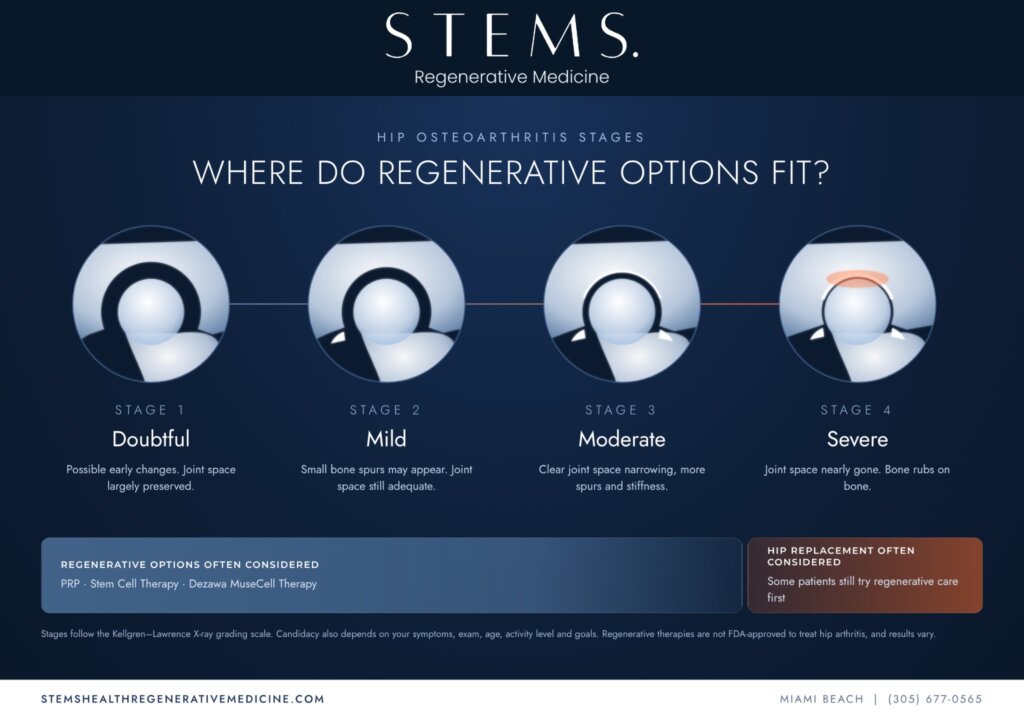
- Have mild to moderate hip arthritis (stages 1 to 3)
- Still have some joint space left on X-ray
- Got short-lived relief from cortisone
- Want to stay active or delay surgery
- Aren’t good candidates for surgery right now
Patients with severe, bone-on-bone arthritis, collapse of the femoral head, or significant deformity are often better served by hip replacement. Some still choose to try regenerative care first, and we’ll give you an honest view of the odds.
What to Expect at STEMS Health
Your visit starts with a full evaluation of your hip pain by Dr. Jarred Mait or Dr. Ankeet Choxi. We’ll review your imaging, rule out other sources such as the spine, SI joint, or bursitis, and explain which options fit your stage of arthritis. Treatment takes place in our Miami Beach office, and most patients go home the same day. Considering other joints too? See our guide to knee replacement alternatives.
Hip Pain Relief with Regenerative Medicine – Frequently Asked Questions
Can stem cells regrow hip cartilage?
There’s no proof that injections regrow lost cartilage in people. The main goals are less pain, less inflammation, and better function.
Is PRP or stem cell therapy better for hip arthritis?
It depends on your stage. PRP is often used for milder arthritis, while stem cell therapy may be considered for moderate cases.
How long does relief last after a regenerative injection?
It varies. Many studies follow patients for six to 12 months, and some report longer benefit.
Can I have regenerative treatment if I’ve had cortisone shots?
Yes. Your physician will usually wait several weeks after a steroid injection.
Will regenerative treatment stop me from getting a hip replacement later?
No. Trying a nonsurgical option first doesn’t rule out surgery later.
How long is recovery after a hip injection?
Most people return to normal daily activity within a few days, then build back to exercise over several weeks.
Do I need an MRI before treatment?
Not always. X-rays usually show the arthritis stage, but an MRI may help if a labral tear or other problem is suspected.
Does hip arthritis pain show up in the knee?
Yes. Hip pain often refers to the thigh or knee, which is why a careful exam matters.
Am I too old for regenerative treatment?
Age alone doesn’t rule you out. Your overall health and arthritis stage matter more.
Does insurance cover PRP or stem cell therapy for the hip?
Usually not. Ask us about financing options.
Explore the Alternatives to Hip Surgery with a Free Consultation at STEMS Health

If hip pain is limiting your life but you’re not ready for surgery, a consultation can help you understand every option. Book a visit with STEMS Health Regenerative Medicine in Miami Beach or call (305) 677-0565.
References
- Shichman I, Roof M, Askew N, et al. Projections and epidemiology of primary hip and knee arthroplasty in Medicare patients to 2040-2060. JBJS Open Access. 2023;8(1):e22.00112.
- Gazendam A, Ekhtiari S, Bozzo A, Phillips M, Bhandari M. Intra-articular saline injection is as effective as corticosteroids, platelet-rich plasma and hyaluronic acid for hip osteoarthritis pain: a systematic review and network meta-analysis of randomised controlled trials. Br J Sports Med. 2021;55(5):256-261.
- Dallari D, Stagni C, Rani N, et al. Ultrasound-guided injection of platelet-rich plasma and hyaluronic acid, separately and in combination, for hip osteoarthritis: a randomized controlled study. Am J Sports Med. 2016;44(3):664-671.
- Kompel AJ, Roemer FW, Murakami AM, Diaz LE, Crema MD, Guermazi A. Intra-articular corticosteroid injections in the hip and knee: perhaps not as safe as we thought? Radiology. 2019;293(3):656-663.
- Biazzo A, Masia F, Verde F. Mesenchymal stem cell therapy for hip osteoarthritis: a systematic review. Acta Orthop Belg. 2021;87(e-Suppl 1).
- Dall’Oca C, Breda S, Elena N, Valentini R, Samaila EM, Magnan B. Mesenchymal stem cells injection in hip osteoarthritis: preliminary results. Acta Biomed. 2019;90(1-S):75-80.
- Mardones R, Jofré CM, Tobar L, Minguell JJ. Mesenchymal stem cell therapy in the treatment of hip osteoarthritis. J Hip Preserv Surg. 2017;4(2):159-163.
- Kuroda Y, Kitada M, Wakao S, et al. Unique multipotent cells in adult human mesenchymal cell populations. Proc Natl Acad Sci USA. 2010;107(19):8639-8643.
- Mahmoud EE, Kamei N, Shimizu R, et al. Therapeutic potential of multilineage-differentiating stress-enduring cells for osteochondral repair in a rat model. Stem Cells Int. 2017;2017:8154569.
- U.S. Food and Drug Administration. Important patient and consumer information about regenerative medicine therapies.
