

Reviewed and approved by Dr. Ankeet Choxi.
If you’re living with spinal stenosis, you know how much it can limit your day. A walk through the park, a round of golf, or even a simple trip through the grocery store can bring on aching, numbness, or heaviness in your legs. When standard treatments don’t help, it’s natural to explore alternative spinal stenosis pain relief options.
One area of regenerative research receiving increasing attention is Dezawa MuseCells® (Multilineage-differentiating Stress-Enduring cells). This guide offers a comprehensive analysis of spinal stenosis pain and the data behind the potential pain treatments using Dezawa MuseCells®.
Why Spinal Stenosis Pain Involves More Than a Narrow Spine
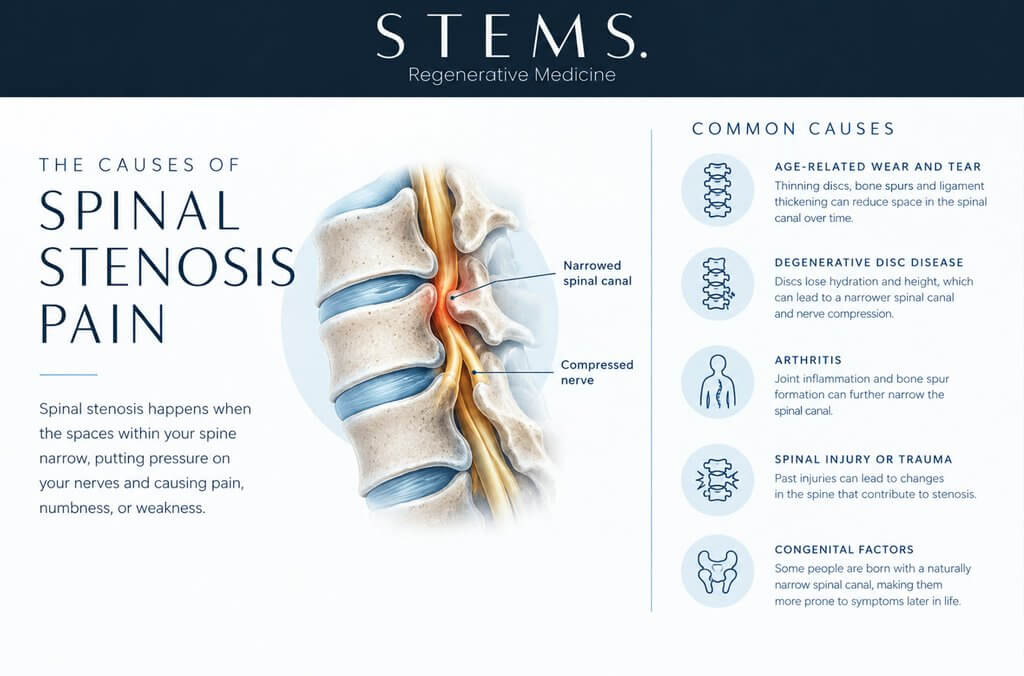
Spinal stenosis is a narrowing of the spaces in the spine, usually caused by age-related changes such as degenerating discs, arthritic facet joints, and thickened ligaments. That narrowing can press on the spinal cord or nerve roots.
The pain isn’t only mechanical. Three biological factors contribute to it:
- Reduced blood flow
Compression can squeeze the small blood vessels that feed the nerves. This is a major reason symptoms flare when standing or walking and ease when sitting or leaning forward.
- Inflammation
Degenerating discs and arthritic joints release inflammatory chemicals that irritate nearby nerves. This is why anti-inflammatory treatments help many patients.
- Nerve damage over time
Long-standing compression can injure nerve fibers. It’s one reason some patients still have symptoms after decompression surgery: relieving the pressure doesn’t always repair damage that has already occurred.
These biological factors are exactly what regenerative medicine doctors hope to address.
Can Dezawa MuseCells® Help Relieve Spinal Stenosis Pain?
While structural issues such as thickened ligaments or bone spurs require physical intervention, the radiating pain of stenosis is largely driven by neuroinflammation and localized nerve damage. This is where Dezawa MuseCells® are showing unique potential in laboratory settings.
Unlike traditional stem cells, Dezawa MuseCells® possess a specialized homing mechanism. They express receptors that detect sphingosine-1-phosphate (S1P), a chemical stress signal released by damaged tissues. This allows them to migrate directly to the site of injury or nerve compression. Once there, recent studies indicate they may address the two major biological components of spinal pain:
1. Controlling Nerve Root Inflammation
When spinal nerves are compressed, localized immune cells (called microglia) become highly active, flooding the area with inflammatory chemicals that cause radiating pain like sciatica.
- The Study
In a 2023 study, Chen et al. investigated whether Dezawa MuseCells® could control this aggressive inflammatory response in the central nervous system.
- What They Studied
The researchers co-cultured human Dezawa MuseCells® with highly inflamed, overactive microglia in a laboratory setting to see if the Dezawa MuseCells® could alter the immune cells’ behavior.
- The Results
The Dezawa MuseCells® significantly reduced the secretion of pain-causing inflammatory chemicals, including tumor necrosis factor-α (TNF-α) and interleukin-1β. More importantly, the cells reprogrammed the microglia from a destructive inflammatory state to a tissue-repairing state by blocking specific inflammatory signaling pathways (Chen et al., 2023). For spinal stenosis patients, this mechanism suggests that Dezawa MuseCells® could potentially calm localized nerve irritation that causes severe leg pain.
2. Repairing Damaged Nerve Tissue
Chronic compression eventually damages nerve fibers, which is why some patients still feel numbness or weakness even after the pressure on the nerve is relieved.
- The Study
A 2023 study by Takahashi et al. tested the regenerative limits of clinical-grade human Dezawa MuseCells® on acute nerve tissue damage.
- What They Studied
The researchers administered human Dezawa MuseCells® intravenously to rats with subacute spinal cord injuries to track whether the cells could locate the injury and restore lost physical function.
- The Results
The researchers confirmed that the Dezawa MuseCells® successfully migrated through the bloodstream directly to the injured spinal cord. Once there, the cells differentiated into functional neural cells and successfully preserved descending nerve fibers. The animal subjects that received the Dezawa MuseCells® showed significantly better motor recovery, regaining the ability to support their weight and take steps, compared to the untreated control group (Takahashi et al., 2023).
While this study focused on direct spinal trauma rather than chronic stenosis, it provides compelling evidence for the cells’ capacity to regenerate damaged neural pathways.
Schedule a Free Spinal Stenosis Pain Consultation

While isolated Dezawa MuseCell® therapies are an exciting research direction, the best results today come from an accurate diagnosis and a treatment plan built around your specific spinal anatomy and mobility goals.
For patients exploring advanced non-surgical options, STEMS Health offers comprehensive evaluations for spinal and lower back pain disorders. Board-certified physicians Dr. Ankeet Choxi and Dr. Jarred Mait focus on cutting-edge, minimally invasive ortho-biologic therapies. These precision-targeted treatments aim to activate the body’s internal repair mechanisms to address underlying tissue damage without the risks or downtime of traditional surgery.
If back or leg pain is preventing you from working or enjoying your favorite activities, schedule a free spinal stenosis pain consultation with STEMS Health or call (305) 677-0565 to speak with our team today about your pain treatment options.
Dezawa MuseCell® Pain Relief for Spinal Stenosis Patients: Frequently Asked Questions
Have Dezawa MuseCells® been tested in humans for spine conditions?
Yes, but for acute trauma rather than chronic stenosis. In 2024, a Phase 1 multicenter clinical trial tested a single intravenous dose of donor (allogeneic) Dezawa MuseCells® in patients with cervical traumatic spinal cord injuries, confirming the treatment was safe and feasible.
What treatments work for spinal stenosis right now?
Options include physical therapy, anti-inflammatory medications, epidural steroid injections, and decompression surgery when needed. For those seeking non-surgical alternatives, modern regenerative medicine offers targeted biologic interventions that can address inflammation and support tissue health.
How do I know if my back pain is spinal stenosis?
Leg pain, numbness, or heaviness that worsens with walking and improves when you sit or lean forward are common signs. A clinical exam and imaging are needed to confirm the diagnosis.
Do patients need immunosuppressive drugs if receiving donor Dezawa MuseCells®?
No. Across published human trials for pain conditions, donor-derived Dezawa MuseCells® have been administered intravenously without human leukocyte antigen (HLA) matching and without immunosuppressive medications. Dezawa MuseCells® possess a unique immunotolerance, expressing biological factors that calm the local immune response.
Who is an ideal candidate for regenerative spine injections?
The best candidates are typically adults with mild to moderate degenerative spinal stenosis or disc disease who have exhausted conservative treatments (such as physical therapy and oral medications) but want to delay or avoid invasive spinal fusion surgery. However, regenerative medicine is not a universal fix. Patients with severe structural stenosis causing progressive neurological deficits, such as foot drop, extreme muscle weakness, or loss of bowel and bladder control, are not suitable candidates for orthobiologics and require immediate surgical evaluation.
References
Chen, X., Yin, X.-Y., Wang, C.-C., et al. (2023). Muse cells decrease the neuroinflammatory response by modulating the proportion of M1 and M2 microglia in vitro. Neural Regeneration Research, 18, 213. https://doi.org/10.4103/1673-
Takahashi, Y., Kajitani, T., Endo, T., et al. (2023). Intravenous Administration of Human Muse Cells Ameliorates Deficits in a Rat Model of Subacute Spinal Cord Injury. MDPI AG. https://doi.org/10.20944/
