

A meniscus injury can turn everyday movements into a constant reminder that something is wrong with your knee. Walking downstairs, getting in and out of a car, squatting, exercising, or standing for an extended period can trigger pain, stiffness, swelling, or a catching sensation inside the joint.
For many patients, frustration grows when initial treatment does not provide lasting relief. Rest may help temporarily. Physical therapy may improve strength and mobility. Medications can make the pain more manageable. Yet the underlying knee problem may continue to interfere with work, exercise, sleep, recreation, and everyday activities.
Meniscus pain patients eventually arrive at the question: “Do I have to live with this pain, or is surgery my only remaining option?”
Regenerative medicine has created another area for patients to explore. Dezawa MuseCell® therapy is an emerging cellular approach being studied for its potential to support biological repair mechanisms and the body’s response to tissue damage. While research specifically examining Dezawa MuseCell® therapy for meniscus injuries is still developing, the initial data hold promise for the millions of meniscus pain patients worldwide.
Why Meniscus Injuries Can Become Persistent
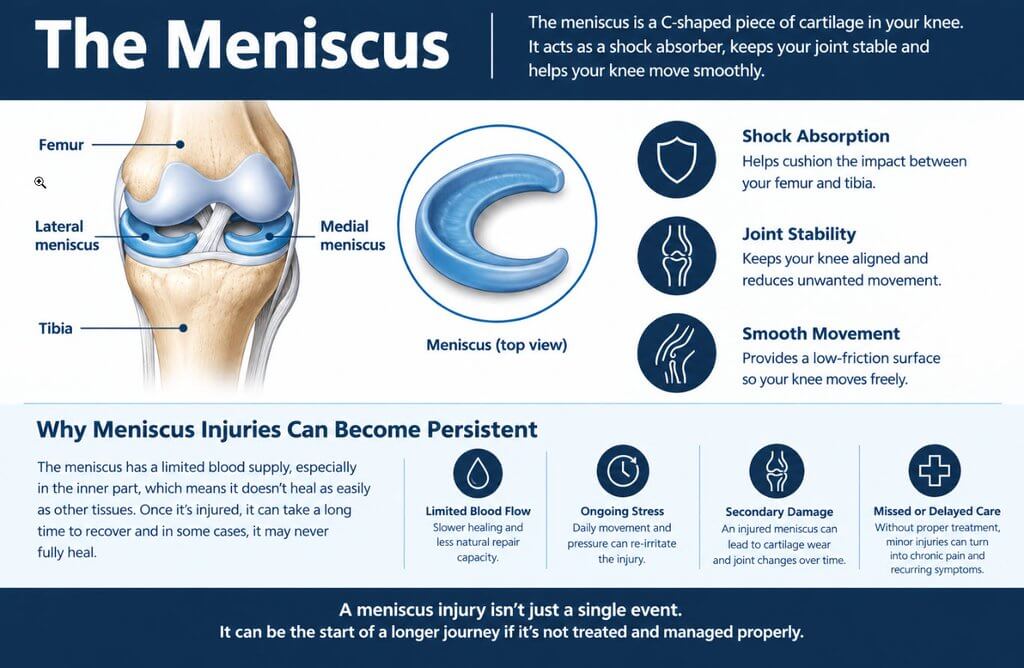
The meniscus consists of two crescent-shaped structures between the femur and tibia. These specialized fibrocartilage tissues help distribute loads across the knee, absorb shock, improve joint stability, and protect the articular cartilage covering the ends of the bones.
Meniscus injuries and damage to the joint disrupt these vital functions.
Symptoms vary according to the type and location of the injury. Some patients experience sharp pain with twisting or pivoting. Others develop swelling, stiffness, clicking, catching, or discomfort after prolonged activity. A more significant tear can interfere with normal knee movement and make certain activities increasingly difficult.
The meniscus’s biological structure also creates a significant challenge for recovery. The outer portion has a relatively better blood supply, while much of the inner meniscus has limited vascularity. Because nutrients, oxygen, and circulating cells reach tissue through the blood supply, the location of the damaged tissue can influence treatment potential.
When Medication Is No Longer the Answer
Medication can have a place in managing an injured knee, particularly during periods of increased pain or inflammation. The problem for some patients is that symptom management becomes the long-term strategy.
You may take medication to get through work. You may avoid certain activities because you know they will aggravate your knee and plan your day around how much walking or standing you can tolerate. Some patients stop exercising because the pain afterward is simply not worth it. The constant pain management can become exhausting.
While some meniscus tears benefit from repair, certain severe injuries make surgical intervention unavoidable due to mechanical symptoms or the nature of the tear. At the same time, not every patient wants to move directly from medication and conservative care to an operation without exploring other possibilities.
Researchers are investigating whether cellular therapies can influence the biological environment of damaged tissue and support the repair process.
The Potential Role for Dezawa MuseCells® in Pain Relief
Dezawa MuseCells® are a distinct population of cells identified within adult human tissues. The acronym comes from their qualities as multilineage-differentiating stress-enduring (MUSE) cells, reflecting characteristics that distinguish them from other cell populations.
Dezawa MuseCells® were identified by Professor Mari Dezawa and colleagues at Tohoku University. Research has investigated their ability to tolerate cellular stress, respond to signals associated with tissue damage, migrate toward injured areas, and differentiate into multiple cell types.
A 2025 review by Mari Dezawa describes MuseCells® as endogenous reparative stem cells with both pluripotent-like and macrophage-like characteristics. The research highlights their ability to respond to sphingosine-1-phosphate, a signal associated with tissue damage, and examines their potential contribution to tissue repair.
Earlier research by Dezawa also examined MuseCells’ contribution to tissue regeneration and their distinction from the broader, heterogeneous population of mesenchymal stem cells.
The Potential Role for Dezawa MuseCell® Therapy in Relieving Meniscus Injury Pain
The scientific interest in Dezawa MuseCell® therapy is partly due to the cells’ response to damaged tissue.
Research has identified mechanisms involving tissue-directed migration and interaction with the injured environment. Rather than thinking of regenerative cells simply as replacement material, researchers are examining how these cells communicate with surrounding tissue and contribute to biological repair.
The distinction matters when discussing a meniscus injury. The meniscus has a collagen-rich extracellular matrix with a structure that allows it to withstand compression, rotation, and repetitive loading. Any regenerative approach must therefore consider the biological and mechanical environment of the meniscus.
Potential areas of interest with Dezawa MuseCell® research include:
- Tissue-directed cellular responses
- Interaction with damaged tissue
- Modulation of inflammatory signaling
- Cellular differentiation
- Paracrine signaling
- Extracellular matrix interactions
- Support of biological repair mechanisms
These mechanisms remain under investigation in relation to meniscus injuries.
MuseCells® in the Context of Meniscus Research and Cellular Therapy
Scientists have investigated mesenchymal stem cells, meniscus-derived cells, synovial cells, and other populations as potential tools for meniscus repair. Much of this research remains preclinical, although some cellular approaches have progressed into early human studies.
For example, researchers studying human meniscus stem/progenitor cells found that intra-articular administration promoted meniscus regeneration in an animal model. The studied subjects showed increased new tissue formation and experienced improvements in extracellular matrix organization. The researchers also identified signaling through the SDF-1/CXCR4 pathway as part of the cellular homing process.
Another study published in the journal Signal Transduction and Targeted Therapy investigated immunity-and-matrix-regulatory cells in patients with meniscus injuries. The Phase I trial involved 18 patients and reported safety over 12 months, along with MRI and functional findings that supported further investigation.
The Potential of Tissue Signaling
Instead of viewing treatment as simply placing cells into a damaged joint, researchers are studying the interaction between the administered cells and the biological environment surrounding the injury. Meniscus pain relief requires coordinated activity among many tissues, including fibrocartilage cells, collagen, proteoglycans, synovial tissue, inflammatory mediators, blood supply, and mechanical loading.One of the most interesting aspects of Dezawa MuseCell® research involves how these cells respond to the biological environment created by tissue injury.
Damaged tissue releases signaling molecules. These signals can influence surrounding cells and activate pathways associated with inflammation and repair. Dezawa MuseCell® research has examined the role of sphingosine-1-phosphate and its receptor signaling in directing cells toward damaged areas.
What About Cartilage and Osteochondral Research?
Meniscus injuries often occur alongside other changes within the knee, including cartilage damage. This makes research involving cartilage and osteochondral tissue relevant to the broader scientific discussion.
A recent study investigated Dezawa MuseCells® and non-MuseCells in an osteochondral injury model. The researchers reported better healing of osteochondral lesions in the cell-treated groups compared with controls and found greater chondrogenic differentiation potential for Muse cells in vitro. The investigators also noted that questions remain regarding the precise contribution of Muse cells to cartilage repair.
That is encouraging from a research perspective. It is precisely this combination of promising biology and developing clinical evidence that makes careful patient evaluation so important.
Can Regenerative Treatment Replace Meniscus Surgery?
There is no single answer for every meniscus injury.
Some meniscus injuries are appropriate for conservative management. Others have mechanical characteristics that make surgical repair more appropriate. A displaced tear that restricts knee motion, for example, presents a different clinical situation from a stable tear causing activity-related discomfort.
For patients who have persistent symptoms, however, understanding nonsurgical options before making a surgical decision can be valuable.
The table below explains the factors to evaluate when comparing regenerative treatment and surgical care for meniscus patients.
| Factor | Consider Regenerative Treatment | Consider Surgery (Repair or Partial Meniscectomy) |
| Tear Type & Complexity | Incomplete, interstitial, partial-thickness tears, or degenerative fraying | Complex, displaced bucket-handle tears, or flap tears with loose fragments |
| Vascular Zone | Red-white or white-white zones with degenerative wear, or as an adjunct in the red-red zone | Outer red-red zone (high vascularity ideal for suture repair) or mechanical blocks requiring trim |
| Mechanical Symptoms | None, or intermittent ache and mild swelling with no locking | True mechanical catching, clicking with pain, joint locking, or inability to fully extend |
| Knee Stability | Structurally stable ligaments (intact ACL/PCL/collaterals) | Unstable knee or combined injuries (e.g., ACL rupture + meniscus repair needed) |
| Underlying Joint Health | Mild to moderate knee osteoarthritis where preserving all native tissue is paramount | Minimal or no arthritis; younger patients where preserving cartilage prevents rapid degeneration |
| Patient Age & Activity | Middle-aged or older individuals with gradual-onset degenerative wear | Younger athletes or active individuals with acute, high-energy traumatic tears |
| Symptom Duration | Chronic or persistent discomfort after failing conservative PT and rest | Acute locked knee (urgent surgical repair) or persistent failure of non-surgical pathways |
| Primary Goal | Pain reduction, modulating inflammation, and biological tissue preservation | Restoring mechanical motion, eliminating joint locking, or suturing repairable tissue |
Current orthopedic guidance emphasizes preservation of functional meniscal tissue when surgery is required. Research into cellular and tissue-engineering approaches is also driven in part by the recognition that preserving or restoring meniscal function may be preferable to simply removing damaged tissue.
For someone who has already tried medication, physical therapy, activity modification, or other conservative approaches, a regenerative medicine consultation can provide an opportunity to discuss whether Dezawa MuseCell® therapy belongs in the treatment conversation.
Who May Be a Candidate for Dezawa MuseCell® Therapy?
A patient with a meniscus injury may want to explore regenerative medicine when persistent symptoms continue to interfere with normal life despite previous treatment.
This may include patients who experience:
- Ongoing pain along the knee joint
- Pain when walking, climbing stairs, squatting, or turning
- Swelling or stiffness after activity
- Catching or discomfort during movement
- Difficulty exercising because of knee pain
- Recurring symptoms despite medication
- Limited improvement after physical therapy
- Frustration with relying on pain medication
- Concern about proceeding directly to surgery
- A desire to explore regenerative options before making a surgical decision
The evaluation should begin with understanding the injury itself.
MRI findings can help identify the location and characteristics of the tear, while a physical examination provides additional information about knee stability, range of motion, mechanical symptoms, and other potential sources of pain.
The condition of the articular cartilage and surrounding structures also matters.
A regenerative medicine physician can use this information to determine whether Dezawa MuseCell® therapy is a reasonable option to discuss.
Find Out Whether Dezawa MuseCell® Therapy May Be Right for Your Meniscus Injury
If you are living with persistent meniscus pain, relying on pain medication, limiting the activities you enjoy, or facing the possibility of surgery, STEMS Health Regenerative Medicine can help you explore whether Dezawa MuseCell® therapy may be an appropriate option for your knee condition.
If you are looking for another approach to persistent meniscus pain, schedule a free consultation with STEMS Health to discuss your injury and learn whether Dezawa MuseCell® therapy may be appropriate for you.
Your free consultation will focus specifically on your meniscus injury, your MRI findings, the treatments you have already tried, and how your knee pain is affecting your daily life.
Frequently Asked Questions
Can Dezawa MuseCell® therapy treat pain associated with a torn meniscus?
While MuseCells® show exciting potential in laboratory research, Dezawa MuseCell® therapy is currently an investigational approach rather than a standard treatment for meniscus pain. Early preclinical studies suggest these unique cells may help reduce inflammation and support tissue repair.
Can Dezawa MuseCell® therapy help me avoid surgery?
Patients sometimes seek regenerative medicine because they want to explore nonsurgical options before proceeding with an operation. Whether surgery can be avoided depends on the tear pattern, location, mechanical symptoms, associated cartilage or ligament damage, and response to previous treatment.
What if I have been taking pain medication for my meniscus injury?
Persistent reliance on medication may be a reason to have the knee reevaluated, particularly if pain continues to interfere with normal activities. Medication can help control symptoms, but it does not necessarily address the biological or structural characteristics of a meniscus injury. A comprehensive evaluation can help determine whether another treatment strategy should be considered.
Are Dezawa MuseCells® the same as traditional mesenchymal stem cells?
No. Dezawa MuseCells® are a distinct population identified within adult tissues and have been studied for characteristics including stress tolerance, tissue-directed migration, multilineage differentiation, and interactions with damaged tissue. The broader term “stem cell therapy” encompasses many different cell populations and treatment approaches.
Does the location of my meniscus tear affect treatment?
Yes. The meniscus has regions with different levels of vascularity, which can influence natural healing potential. The size and pattern of the tear, its location, the condition of surrounding cartilage, and the presence of mechanical symptoms can all affect treatment decisions.
Do I need an MRI before considering Dezawa MuseCell® therapy?
MRIs can provide important information about the meniscus and other structures within the knee. If you already have an MRI, bringing the images and report to your consultation can help the physician understand the injury. Additional imaging may be recommended depending on your symptoms and existing records.
What should I do if I have persistent meniscus pain and want an alternative to surgery?
The first step is a detailed evaluation of the injury and your treatment history. If you continue to experience pain despite medication, physical therapy, activity modification, or other conservative treatment, ask whether regenerative medicine may be appropriate for your situation. STEMS Health can evaluate your knee and discuss whether Dezawa MuseCell® therapy should be considered as part of your treatment options.
