

For patients with chronic knee pain, whether due to osteoarthritis, meniscus tears, or old sports injuries, stem cell therapy is a compelling alternative to major surgery. Unlike total knee replacement, which removes the joint, stem cell therapy aims to preserve it by utilizing the body’s own regenerative mechanisms to reduce inflammation and signal tissue repair.
When you’re reviewing knee pain relief options and considering stem cell treatment, one of the most pressing questions is “How long will the relief last?”
While there is no single answer that applies to every patient, clinical data and patient outcomes have established a general timeline for the longevity of stem cell therapy’s pain-relieving effects. Understanding this timeline requires knowing how the therapy works, the factors that impact its effective duration, and the role of ongoing maintenance within the recovery roadmap.
The Typical Results Duration After Stem Cell Treatment for Knee Pain
For the majority of patients who respond well to treatment, the pain-relieving effects of stem cell therapy for knee pain typically last between two and five years.
It is important to separate stem cell injections from steroid injections (cortisone), which mask pain for a few weeks or months, or hyaluronic acid (gel) injections, which typically last six months to a year. Stem cell therapy is fundamentally different because it is a biological agent that can change the environment of the joint.
Stem cell knee pain patients fall into three categories:
- The “Short” Responders (6 months – 1 year)
Patients with severe, bone-on-bone arthritis (Grade 4) often fall into this category. The structural damage may be too advanced for the cells to reverse, so the primary benefit is a temporary reduction in inflammation.
- The “Average” Responders (2 – 5 years)
2-to-5 years of knee pain relief is typical for stem cell patients with mild to moderate osteoarthritis (Grades 2-3). In these cases, the therapy can successfully modulate the immune response, mitigate chronic inflammation, and perhaps improve the health of the remaining cartilage, leading to years of improved function.
- The “Long” Responders (5+ years)
Younger patients or those treating specific, isolated soft tissue injuries (such as a partial meniscus tear or MCL sprain) rather than generalized arthritis may experience permanent or semi-permanent relief after stem cell injections, as the tissue heals rather than just being managed.
The Timeline of Knee Pain Relief Results: What to Expect After Stem Cell Treatment
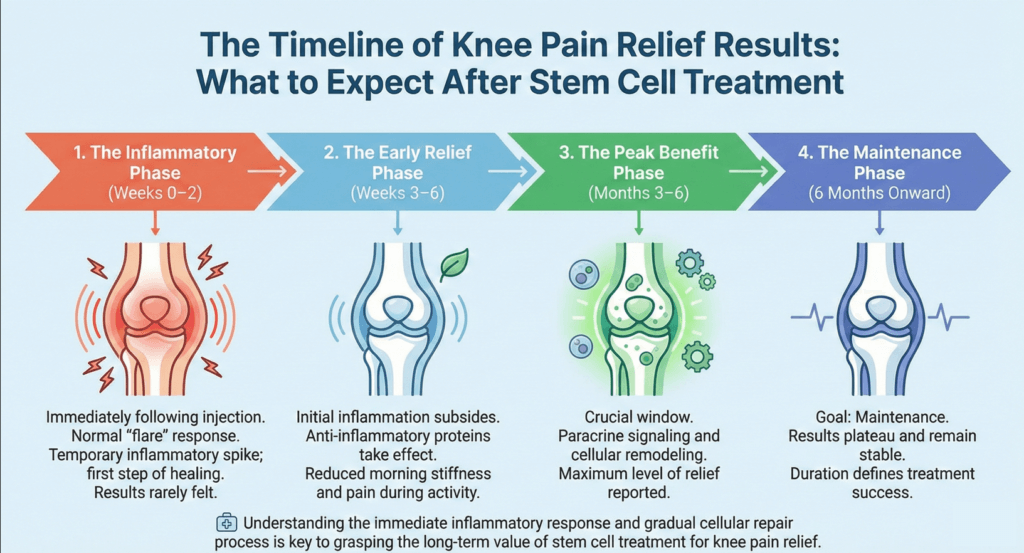
By understanding how relief from knee pain begins in the immediate days and weeks after a stem cell treatment, you can gain a better grasp of its long-term value.
1. The Inflammatory Phase (Weeks 0–2)
Immediately following the injection, many patients feel more pain or stiffness. This is a normal “flare” response. The introduction of biological material causes a temporary inflammatory spike, which is actually the first step of the healing cascade. Results are rarely felt during this window.
2. The Early Relief Phase (Weeks 3–6)
As the initial inflammation subsides, the potent anti-inflammatory proteins released by the stem cells begin to take effect. Patients typically notice a reduction in morning stiffness and pain during activity.
3. The Peak Benefit Phase (Months 3–6)
This is the crucial window. Stem cells work by paracrine signaling and guide your body’s repair cells. This cellular remodeling takes time. Most patients report their maximum level of relief around the 3 to 6-month mark.
4. The Maintenance Phase (6 Months Onward)
Once peak improvement is achieved, the goal becomes maintenance. The results tend to plateau and remain stable. The duration of this stability is what defines the “success” of the treatment.
Which Factors Influence the Longevity of My Knee Pain Stem Cell Treatment Results?
Why does one patient achieve five years of relief while another experiences six months? The durability of the treatment depends on the following factors:
The Stage of Knee Joint Damage
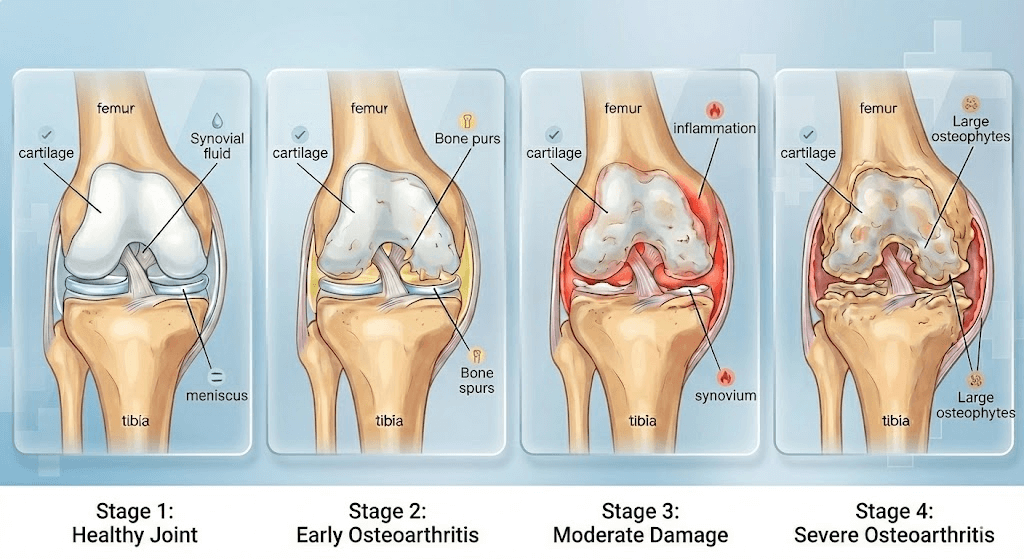
Stage 1: Minor
Stage 1: Minor (The Warning Phase) There is very little wear and tear at this point. You might have tiny “bone spurs” (small bony growths) starting to form, but you likely feel little to no pain. Stem cell treatments are rarely needed at this stage, but would have the highest potential longevity.
Stage 2: Mild
This is when most patients notice symptoms. You may experience stiffness after sitting for a long time or pain after a workout. X-rays may show bone spurs, but the space between your bones is still healthy. Stem cell therapy is often highly effective during this mild stage, as there is plenty of cartilage left to protect.
Stage 3: Moderate
The cartilage is visibly eroding, and the gap between the bones is narrowing. Simple activities such as walking or climbing stairs become painful. Because the “cushion” is thinning, the stem cells must work harder to manage inflammation. The results can still be very significant when treatment begins at the moderate phase.
Stage 4: Severe
In this stage, the cartilage is almost entirely gone. The bones are rubbing against each other, leading to intense pain and decreased mobility. While stem cells can still provide a “biological reset” to lower pain, the mechanical friction of the bones often means the relief won’t last as long as it would in earlier stages.
Patient Health and Lifestyle
Systemic inflammation is the enemy of stem cell longevity. Patients who smoke, consume high amounts of processed sugar, or carry significant excess weight often see results fade faster. The systemic inflammation in the body quickly reduces the anti-inflammatory capacity of the injected cells.
Conversely, patients who adhere to a strict rehabilitation protocol and maintain a healthy weight can often significantly extend their results.
Precision of Delivery
Blind injections (injecting without imaging guidance) frequently miss the intra-articular space. For results to last, the cells must be placed precisely using fluoroscopy (live X-ray) or ultrasound guidance. If the cells are not placed exactly at the location of damage, the duration of relief may be limited.
The Role of “Booster” Stem Cell Injections
Stem cell therapy is rarely a one-and-done cure for knee pain conditions like arthritis, because arthritis itself is a progressive disease. The therapy helps stall the degeneration and support the knee joint, but it doesn’t stop the aging process.
Your stem cell doctor may recommend a maintenance approach to enduring knee pain relief, which can include:
- PRP Boosters: Using Platelet-Rich Plasma (PRP) injections 6 to 12 months after the initial stem cell procedure to support the area and reactivate the healing response.
- Repeat Stem Cell Procedures: Repeating the full stem cell procedure every 3 to 5 years to maintain joint preservation and delay knee replacement surgery indefinitely.
Explore the Potential of Stem Cells for Relief of Your Knee Pain with STEMS

Stem cell therapy offers a middle ground between the temporary relief provided by cortisone injections and the painful recovery associated with surgery. The board-certified Miami stem cell doctors at STEMS Health can help you optimize the longevity of your knee pain relief and restore function in damaged joints.
Schedule your free consultation today to explore the potential of stem cell treatments for your knee pain.
Answers to Your Stem Cell Treatments for Knee Pain Questions
Will I need to repeat the treatment?
Likely, yes, if your goal is to manage a chronic condition like arthritis for the rest of your life without surgery. Most patients view stem cell therapy as a management tool. You might require a repeat treatment every 3 to 5 years.
How do I know if the treatment has “worn off”?
The return of pain is usually gradual, not sudden. You may notice that morning stiffness returns, or that you are reaching for over-the-counter pain relievers (Advil/Tylenol) more frequently after activity. When your bad days start outnumbering your good days again, the treatment effects have likely subsided.
Does age affect the pain-relieving duration of stem cell injections?
Yes. Generally, younger patients experience longer-lasting results because their bodies are more efficient at tissue repair. However, older patients can still achieve multi-year relief, especially if they work with board-certified stem cell doctors who have achieved results in complex knee pain cases.
What can I do to make the results last longer?
The best steps for extending knee pain relief results after stem cell treatment:
- Weight Management: Every pound of body weight places 4 pounds of pressure on the knee. Losing weight significantly reduces mechanical stress.
- Low-Impact Strength Training: Strengthening the quadriceps and hamstrings (muscles supporting the knee) without high-impact pounding helps protect the joint.
- Supplements: Supplements such as Curcumin (turmeric) and Omega-3 fatty acids can help reduce systemic inflammation.
If I have bone-on-bone arthritis, will I experience a shorter period of relief?
In Stage 4 osteoarthritis, the mechanical wear and tear is significant. While stem cells can provide significant pain relief by changing the chemical environment of the knee, they cannot fully regrow the cartilage cushion. Consequently, the mechanical grinding eventually brings the inflammation back. Expect results between 6 months and 1.5 years for severe cases, rather than the 3-5 year range.
Sources:
Davatchi, F., et al. (2016). Mesenchymal stem cell therapy for knee osteoarthritis: 5 years follow-up of three patients. International Journal of Rheumatic Diseases, 19(3), 319-325.
Kim, S. H., et al. (2020). Impact of Kellgren–Lawrence grade on clinical outcomes following adipose-derived stem cell therapy for knee osteoarthritis: A propensity score–matched retrospective cohort study. Stem Cell Research & Therapy. Koh, Y. G., et al. (2013). Mesenchymal stem cell injections improve symptoms of knee osteoarthritis. Arthroscopy: The Journal of Arthroscopic & Related Surgery, 29(4), 748-755.
Mora, M., et al. (2018). Mesenchymal Stromal Cell-Derived Immunomodulation: A Perspective on the Treatment of Inflammation and Autoimmunity. Frontiers in Immunology, 9, 2368.
Harrell, C. R., et al. (2019). Mesenchymal Stem Cell Exosomes as a New Therapeutic Approach for Osteoarthritis. Cells, 8(12), 1642.
Tang, Y., et al. (2023). Obesity hinders the efficacy of adipose-derived stem cells for knee osteoarthritis. Stem Cell Research & Therapy.
