

Reviewed by Dr. Ankeet Choxi, and Jarred Mait, MD
Stem cells are a foundational concept in regenerative medicine, yet the term is often used without clear explanation. At STEMS Health Regenerative Medicine in Miami Beach, patient education is an important part of informed decision-making, especially when exploring advanced or emerging medical therapies.
At its most basic level, a stem cell is a type of cell with two defining abilities: it can replicate itself, and it can develop into other kinds of cells. These properties allow stem cells to support growth, maintenance, and repair throughout the body.
This guide explains what stem cells are, how they work, and the main types studied in modern medicine. It is intended as an educational overview, using simple analogies and minimal jargon.
What Are Stem Cells?
Stem cells are often described as the body’s starting-point cells. Unlike most cells, which are already specialized to perform a specific function, stem cells begin in a more flexible state. They can either remain as stem cells or develop into more specialized cells with defined roles.
A useful analogy is to think of stem cells as blank keys. A blank key does not open any door until it is cut. Once shaped, it works with a specific lock. In a similar way, stem cells can remain unshaped – continuing to replicate themselves – or they can be shaped into cells such as muscle cells, nerve cells, or blood cells.
This flexibility is what makes stem cells central to both natural biology and regenerative medicine research.
Stem Cells and Self-Renewal
One defining feature of stem cells is self-renewal, meaning they can divide and create copies of themselves over long periods of time.
Most cells in the body have a limited lifespan. For example, skin cells are constantly replaced, but each individual skin cell can divide only a certain number of times. Stem cells behave differently. They act more like a master copier that does not wear out – each copy leaves the original intact.
Self-renewal allows the body to maintain a steady supply of stem cells and provides a reserve for tissue maintenance and repair.
Stem Cell Differentiation Explained
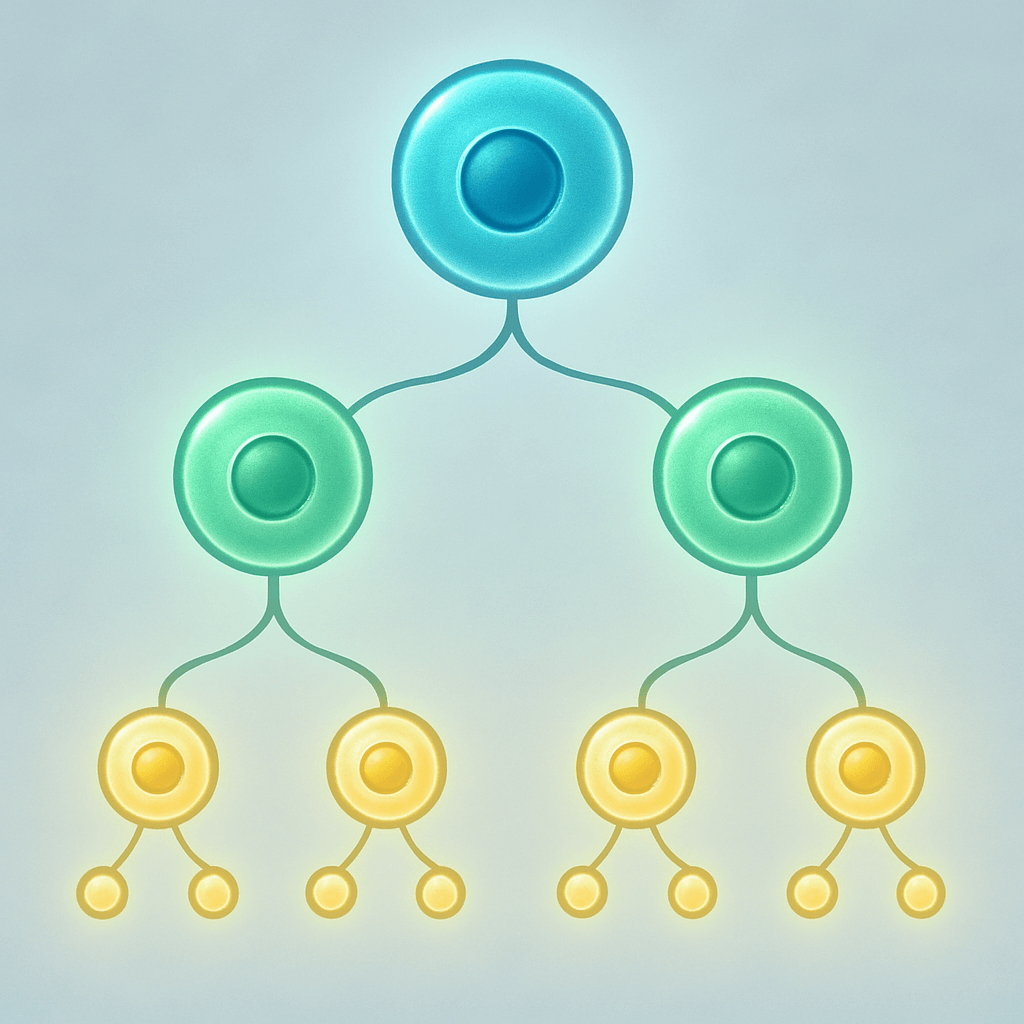
The second defining feature of stem cells is differentiation, the process by which a stem cell becomes a specialized cell.
Differentiation can be compared to choosing a career path. A student begins with general education, then later specializes in a specific field. Similarly, a stem cell begins in a general state and later commits to becoming a specific type of cell.
Once a stem cell differentiates, it typically cannot revert to its earlier flexible state. A nerve cell remains a nerve cell, and a muscle cell remains a muscle cell. This specialization allows tissues and organs to function properly.
How Stem Cells Work in the Body
Stem cells are active participants in normal biological processes. From early development through adulthood, they contribute to growth, maintenance, and repair.
In adults, stem cells are found in specific tissues such as bone marrow, skin, and the digestive tract. These cells replace worn-out or damaged cells as part of routine maintenance. Blood stem cells, for example, continually produce new red and white blood cells to replace those that naturally break down.
At clinics like STEMS Health, much of the clinical discussion around stem cells focuses on how these natural repair mechanisms are being studied and applied within regulated medical frameworks.
Cell Signaling and Microenvironments
Stem cells do not function independently. Their behavior is guided by cell signaling pathways and by their surrounding environment, often called the cellular “microenvironment” or “niche.”
Cells communicate through chemical signals, similar to messages sent across a network. These signals help determine whether a stem cell should divide, remain inactive, or differentiate into a specific cell type.
The surrounding tissue also matters. A stem cell in bone marrow receives different signals than one in muscle or cartilage, influencing how it behaves and what it becomes.
Main Types of Stem Cells
Stem cells are generally categorized into three main types based on their origin and biological potential: embryonic stem cells, adult stem cells, and induced pluripotent stem cells. Each type has different characteristics and research applications.
Understanding these distinctions helps clarify how stem cells are studied and, in some cases, used in medical settings.
Embryonic Stem Cells
Embryonic stem cells are derived from very early stages of development, typically from embryos that are only a few days old. These cells are considered pluripotent, meaning they can develop into nearly any cell type in the body.
Because of this broad developmental potential, embryonic stem cells are widely used in research to study early human development and disease formation. Their use is subject to ethical considerations and regulatory oversight, which vary by jurisdiction.
Pluripotency Explained
Pluripotency refers to a cell’s ability to develop into many different cell types. A pluripotent cell can be thought of as a master template that can be adapted for multiple purposes, depending on the instructions it receives.
While this flexibility is valuable for research, pluripotent cells require careful control. Without proper regulation, their development can be unpredictable, which is why their use is primarily limited to laboratory research.
Adult Stem Cells
Adult stem cells, sometimes referred to as tissue-specific stem cells, are found in developed tissues throughout the body. Unlike embryonic stem cells, adult stem cells usually differentiate into a narrower range of cell types related to their tissue of origin.
For example, stem cells in bone marrow primarily produce blood cells, while stem cells in connective tissue may support bone, cartilage, or tendon repair. These cells are involved in routine maintenance and healing.
Adult stem cells are a frequent focus of regenerative medicine discussions at practices such as STEMS Health, particularly in the context of musculoskeletal and joint-related care.
Mesenchymal and Hematopoietic Stem Cells
Two commonly discussed adult stem cell types are hematopoietic stem cells and mesenchymal stem cells.
Hematopoietic stem cells are found in bone marrow and are responsible for producing blood cells, including red blood cells, white blood cells, and platelets. Their clinical role is well established in bone marrow transplantation.
Mesenchymal stem cells are found in tissues such as bone marrow, fat, and connective tissue. They can differentiate into cells like bone, cartilage, and fat cells and are studied for their supportive and signaling roles within tissues.
Induced Pluripotent Stem Cells (iPSCs)
Induced pluripotent stem cells, or iPSCs, are adult cells that have been reprogrammed to behave similarly to embryonic stem cells. This process involves altering how genes are expressed so the cell returns to a more flexible state.
iPSCs allow researchers to study disease mechanisms using patient-specific cells and to test potential therapies in controlled environments.
How Cell Reprogramming Works
Cell reprogramming can be compared to resetting a device to factory settings. A specialized cell, such as a skin cell, has a fixed identity. Reprogramming removes many of those instructions, allowing the cell to start over.
While iPSC technology has expanded research possibilities, it remains an area of ongoing study, with scientists continuing to examine safety, consistency, and long-term behavior.
Common Misunderstandings About Stem Cells
Stem cells are sometimes discussed as if all types function the same way or are universally applicable to treatment. In reality, different stem cells serve different roles, and not all are appropriate for every condition.
Another common misunderstanding is that research findings immediately translate into approved therapies. Most stem cell-related research requires extensive clinical testing and regulatory review before becoming part of standard medical practice.
STEMS Health emphasizes evidence-based education so patients can better understand the distinction between research, clinical trials, and established treatments.
Why Stem Cell Research Matters
Stem cell research helps scientists better understand how tissues develop, maintain themselves, and respond to injury or disease. These insights support advances in disease modeling, drug testing, and regenerative medicine.
By studying how stem cells differentiate and interact with their environment, researchers gain valuable information about conditions ranging from degenerative joint disease to genetic disorders.
Understanding the Basics of Stem Cells
Stem cells are defined by their ability to self-renew and differentiate. These properties allow them to support growth, maintenance, and repair throughout the body. The three main types – embryonic stem cells, adult stem cells, and induced pluripotent stem cells – each play distinct roles in research and medicine.
For patients and readers of the STEMS Health blog, understanding these basics provides a clearer foundation for informed conversations about regenerative medicine and emerging therapies.
Disclaimer
The information provided in this article is for educational and informational purposes only and is not intended as medical advice. Treatments and outcomes described may not be appropriate for every individual. Always consult a licensed healthcare provider to determine the best course of care for your specific needs.
Certain regenerative medicine procedures discussed – such as stem cell therapy, exosome therapy, or other biologic treatments – may be considered investigational or not FDA-approved for all conditions. Florida law requires that we disclose this status. While these procedures are offered in accordance with state and federal guidelines, their safety and efficacy have not been fully established by the U.S. Food and Drug Administration.
Results vary, and no guarantee of specific outcome or benefit is implied. All medical procedures involve potential risks, which should be discussed with your treating provider prior to treatment.
© STEMS Health Regenerative Medicine, Miami Beach, Florida. All rights reserved.
Below are 3 clear, patient-education–focused FAQs written specifically to support the blog “Guide to How Stem Cell Therapy Works.”
They reinforce process transparency, safety, and realistic expectations, and are suitable for reuse across STEMS Health educational content.
Is stem cell therapy a single treatment or a customized process?
Stem cell therapy is not a single, standardized treatment. It is a multi-step medical process that can vary based on the patient’s condition, cell source, processing methods, and delivery approach. Two patients may both receive stem cell–based care, yet have very different workflows. Understanding each step—evaluation, sourcing, handling, delivery, and follow-up—helps patients better interpret claims and ask informed questions.
Do stem cells actually turn into new tissue after they are delivered?
Not always. While some research explores direct cell integration, much of the current scientific discussion focuses on cell signaling rather than cell replacement. After delivery, stem cells or cell-derived materials may influence the local tissue environment by releasing signals that affect inflammation, cellular activity, and repair processes. These mechanisms are still being studied, and outcomes vary by condition and individual biology.
How long does it take to see results from stem cell therapy?
Regenerative responses are typically gradual, not immediate. Some patients may experience short-term soreness or inflammation after delivery, followed by changes over weeks or months. The timeline depends on factors such as the severity and duration of the condition, overall health, tissue type involved, and adherence to follow-up care or rehabilitation recommendations. No specific outcome or timeframe can be guaranteed.
